Pet Food Packaging • Industry Guide • By XWPAK Manufacturing
Walk into any pet food aisle and count how many bags are competing for the same shelf position. Forty SKUs, sometimes more, all vying for attention at eye level. A buyer, a dog owner, a cat parent they spend under three seconds deciding which bag is worth picking up. In that window, the structure of the bag matters as much as what's printed on it.
This is where quad-seal gusset bags have moved from a premium option to the format of choice. The shift is happening across independent pet food brands, contract manufacturers, and large retailers alike. This guide explains why and covers every material, functional feature, and certification consideration a buyer needs to understand before specifying this format.
A quad-seal bag has four vertical side seals. That sounds like a minor detail, but it changes everything about how the bag behaves when filled, how it stands, and how it looks on a shelf. Compare this to the two most common alternatives: a pillow pouch (two seals, bag puffs out when filled, no defined panels) and a three-seal bag (fin seal down the back, two side seals, slightly more structured but still tapers). Neither can match the quad-seal's flat, squared geometry.
When a quad-seal bag is filled, it forms four distinct flat panels front face, back face, and two gusset side panels. All four are printable surfaces. On a pillow pouch, you get two curved faces that distort printed artwork when the bag is full. On a quad-seal, your branding, nutritional panel, certifications, and product photography are all flat, stable, and readable from every angle on the shelf.
The flat base is the other structural advantage. Quad-seal bags stand upright without a formed base insert. This matters for shelf-ready packaging and for consumers storing large bags of dry food at home. It is not a coincidence that most premium pet food brands from those sold at independent pet retailers to those on supermarket shelves moved to this format years ago.
Panel breakdown: Front panel (primary branding), back panel (nutritional information, ingredients, legal text), left gusset panel (certifications, usage guide, QR code), right gusset panel (additional imagery or secondary branding). The side gusset panels are underused by most brands they represent free printable real estate that two-seal formats simply do not offer.
The right laminate structure for a pet food quad-seal bag depends on the product inside its moisture content, oil content, shelf life target, fill weight, and the regulatory markets it will be sold in. There is no single correct answer, but there is a framework for making the right call.
A kraft outer layer with a polyethylene inner gives a natural, craft aesthetic that performs well for natural and organic pet food brands. The texture communicates quality without printing a word. The barrier performance is moderate suitable for dry kibble with low fat content sold within four to six weeks of manufacture. It is not the right structure for fish-based food, high-fat raw treats, or products destined for international shipping with long transit times.
KPET laminates offer high clarity and excellent oxygen barrier properties. This structure is the workhorse of the premium dry pet food market it protects against oxidation, preserves fats and proteins, and gives a clean gloss finish that suits photographic print designs. When a brand wants to show the kibble through a window panel, KPET laminate behind the cut-out gives the clearest view.
Heavy kibble, sharp-edged dental chews, and bone-shaped treats put mechanical stress on packaging that softer laminates cannot handle. Nylon outer layers are puncture-resistant and dimensionally stable under load. For 5kg and 15kg formats, a nylon-based laminate significantly reduces pinhole failures during palletised shipping a problem that costs more to fix after the fact than it does to specify correctly at the start.
Vacuum-metallised polyester provides maximum barrier performance against oxygen, moisture, and light. This is the correct choice for raw freeze-dried pet food, air-dried products, fish-based formulas, and anything with a shelf life target of twelve months or more. The metallic interior also gives the bag a premium feel when opened. If your product is sensitive and your margin supports a higher-barrier structure, foil laminate is the specification.
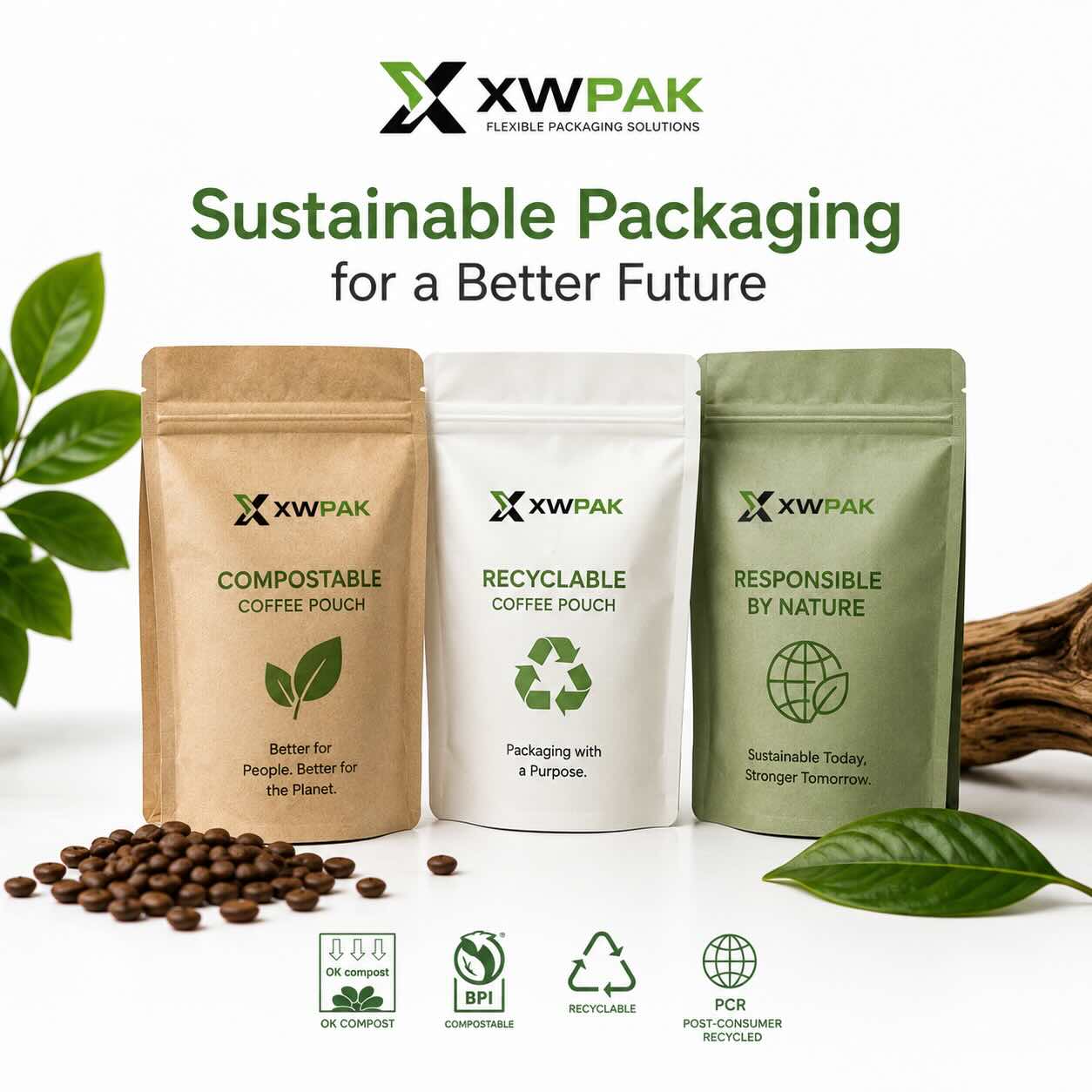
PLA-based or NatureFlex inner layers with a kraft outer give a fully compostable structure. There is an important distinction between home compostable and industrially compostable that matters for how you make on-pack claims.
Home compostable structures (certified to TÜV AUSTRIA OK Compost HOME or AS 5810) break down in ambient garden compost conditions. They are suitable for consumers who actually compost at home. Industrially compostable structures (certified to EN 13432 or ASTM D6400) require sustained temperatures of 58°C or higher to break down — they do not degrade in home compost bins and should not be labelled as home compostable. Using the wrong claim on-pack is a regulatory breach under the EU Green Claims Directive and UK CMA Green Claims Code.
Mono-material polyethylene or polypropylene structures where every layer including the sealant, zipper, and print substrate is the same polymer family are fully recyclable via LDPE drop-off collection in the UK and increasingly via kerbside collection in the EU. These structures now achieve oxygen barrier performance suitable for dry pet food through EVOH co-extrusion or SiOx barrier coatings, without introducing incompatible materials. For brands with EU or UK market exposure that need to meet 2030 packaging regulation targets, mono-material is the direction of travel. We print all structures with bio-based inks, which eliminates ink contamination as a concern in the recycling stream.
| Material | Oxygen Barrier | Moisture Barrier | Recyclable | Compostable |
|---|---|---|---|---|
| Kraft / PE | Low | Medium | No | No |
| KPET | High | High | No | No |
| Nylon / PE | High | High | No | No |
| Foil (VMPET) | Very high | Very high | No | No |
| Mono-material PE | Medium-high | High | Yes | No |
| PLA / NatureFlex | Low-medium | Medium | No | Yes (home) |
| PLA / Kraft | Low | Low-medium | No | Yes (home) |
All of these structures are available as food-grade gusset pouches with custom print and low minimum order quantities.
Material structure determines whether a bag protects the product. Functional features determine whether a bag is usable in practice for the retailer stocking it, the consumer opening it daily, and the fulfillment team packing it. These are not afterthoughts.
A resealable zipper is a baseline expectation in dry pet food packaging. The question is what type. Press-to-close (PTZ) zippers are the most common and the least expensive to produce. They work well for consumers who open the bag occasionally. Coil zippers are more durable and better suited to bags that are opened once or twice daily for months. For a 5kg or 15kg bag that may be in use for six to eight weeks, a coil zipper pays for itself in customer satisfaction. Child-resistant zippers are available for certain supplement or medicated treat products where safe-storage regulations apply.
The position and depth of a tear notch affects how consumers open the bag and whether they reach the zipper cleanly. Notches placed too high above the zipper result in consumers tearing past it and losing the reseal function entirely. Standard positioning is 3 to 5mm above the zipper track on both side seals. Double-notching (left and right side) accommodates left-handed and right-handed users equally a small detail that affects a significant portion of consumers.
Two formats are standard: the euro slot (6mm x 28mm, used by most European and UK retailers) and the butterfly hole (two overlapping circles, used in some US retail environments). Before specifying, confirm what your target retailer requires. A mismatch between the hang hole format and the peg system in-store means the bag cannot be merchandised as intended. For smaller SKUs (250g to 500g treat formats) hang merchandising is often the primary display method, making this more than a secondary consideration.
The K-seal base and the pinch-seal base behave differently when filled. A K-seal base folds diagonally at each corner, creating a slightly tapered base that stands stably but has a smaller footprint. A pinch-seal base folds straight across, giving a wider, flatter base that stands more firmly under heavy fills. For bags above 2kg, a reinforced pinch-seal base is the more stable option particularly important when bags are stacked or displayed without shelf dividers.
Selecting the correct bag dimensions for a given fill weight requires accounting for the bulk density of the specific product, not just the weight. Kibble is significantly less dense than powder a 1kg bag of dry kibble is larger than a 1kg bag of meal-replacement powder. The reference dimensions below are starting points for dry kibble at average bulk density (around 0.40 g/mL).
| Fill Weight | Approx. W x H x G |
|---|---|
| 500g dry kibble | 140 x 220 x 60mm |
| 1kg dry kibble | 160 x 250 x 70mm |
| 2kg dry kibble | 190 x 300 x 85mm |
| 5kg dry kibble | 240 x 380 x 110mm |
| 15kg dry kibble | 380 x 550 x 150mm |
Certification requirements for pet food packaging have become significantly more detailed in recent years. Major retailers now require documentary evidence of compliance before a product can be listed. As a manufacturer, we hold certifications across all of the following standards and can provide technical data sheets and compliance documentation on request.
FDA Food Contact
Required for all pet food packaging sold in the United States. All food-contact layers must comply with 21 CFR regulations for the specific polymer used.
EU Regulation 10/2011
Governs plastic materials and articles intended to contact food in the European Union. Specific migration limits apply by substance and food type.
BRC / BRCGS Packaging
The global standard for packaging manufacturers supplying UK and European retailers. Grade A certification covers hygiene, quality management, and product safety systems.
SEDEX / SMETA
Ethical trade audit standard covering labour rights, health and safety, business ethics, and environment. Required by most major UK and EU supermarket buyers.
FSC Certification
Forest Stewardship Council chain-of-custody certification for all kraft paper-based bag structures. Required by brands making responsible sourcing claims on-pack.
Compostability (TÜV / EN 13432)
TÜV AUSTRIA OK Compost HOME for home compostable structures. EN 13432 or ASTM D6400 for industrially compostable. Both are available with on-pack certification logos.
Print and finish decisions on a quad-seal bag are not purely aesthetic. They affect how the bag behaves physically (matte finishes reduce slip; soft-touch laminate adds grip for large heavy bags), how it performs at shelf (gloss finishes attract fingerprints and smudging; matte holds better in high-humidity retail environments), and what it communicates to a buyer in the first three seconds.
Pet owners respond to seeing the product. A die-cut window covered with clear laminate film or left as a transparency in a kraft-based bag allows the kibble, treat, or food to be visible before purchase. Window placement matters significantly a small central oval on the front panel reads as decorative; a wide horizontal band near the base of the front panel reads as transparency and authenticity. Window position should be confirmed against the fill level of the product so the visible portion shows the product, not empty space.
Matte finishes have become the dominant choice in premium pet food, particularly in the independent and specialist retail segment. They photograph well (important for DTC brands selling online), they do not reflect store lighting in a way that obscures text, and they communicate craft without requiring any visual element to do so. Gloss remains appropriate for mid-market products where visual brightness and colour saturation are priorities. Soft-touch laminate a tactile matte surface that has a velvety feel is used by brands at the top of the price point where the unboxing or shelf-handling experience is part of the value proposition.
Embossed metallic foil on a logo or brand name set against a matte surface creates the highest contrast available in flexible packaging. Spot UV a clear high-gloss coating applied to a specific element on a matte surface — achieves a similar effect with a different aesthetic. Both finishes are applied in the print stage and should be accounted for in the artwork file from the start, not added as afterthoughts. If your brand uses either finish, the artwork file needs to include a separate die-cut layer specifying exactly where the effect is applied.
Switching from a pillow pouch or a three-seal format to a quad-seal bag means your existing artwork will not map directly onto the new panel layout. A design that works on a two-panel bag does not simply transfer to four panels the front and back are narrower relative to the gusset side panels, the hang hole position changes, and the zipper panel affects how the top third of the front face can be used. Our team redesigns existing artwork for the new format, or works from a brief to produce print-ready files from scratch. We use bio-based inks across all print runs, which means brands pursuing B Corp or environmental certifications can include ink as part of their sustainability documentation.
Rotogravure printing produces the sharpest reproduction at high volumes it is the correct method for runs of 500,000 units or more where per-unit cost is the priority and colour consistency across a large run is critical. Digital printing eliminates plate and cylinder tooling costs entirely, making it viable for short runs, personalised editions, seasonal packaging, and testing new designs before committing to volume. For pet food brands with multiple SKUs, flavours, or regional variants, digital print allows different front-panel designs to run sequentially without tooling changes. Flexographic printing sits between the two plate costs are lower than rotogravure, and it is suitable for medium-length runs where digital per-unit cost would be prohibitive but rotogravure volume is not yet reached.
One of the most significant operational advantages in flexible packaging is proximity to stock. Most packaging delays happen not at the print stage but in transit a print run completed correctly is still useless if it takes six weeks to arrive from the other side of the world.
We hold stock in the United States, Canada, the United Kingdom, and across the EU, which means domestic despatch in all major markets. Production starts the same day an order is confirmed. For brands that work to tight launch windows, seasonal campaigns, or short production schedules, this is not a minor operational detail.
Our low minimum order quantities make quad-seal gusset bags accessible to independent pet food brands.
Ready to specify a quad-seal bag for your pet food line?
Browse our full range of wholesale gusset pouches available with custom print, low MOQ, and fast despatch from stock in the US, Canada, UK, and EU. Samples available before you commit to a print run.
View Gusset Pouches