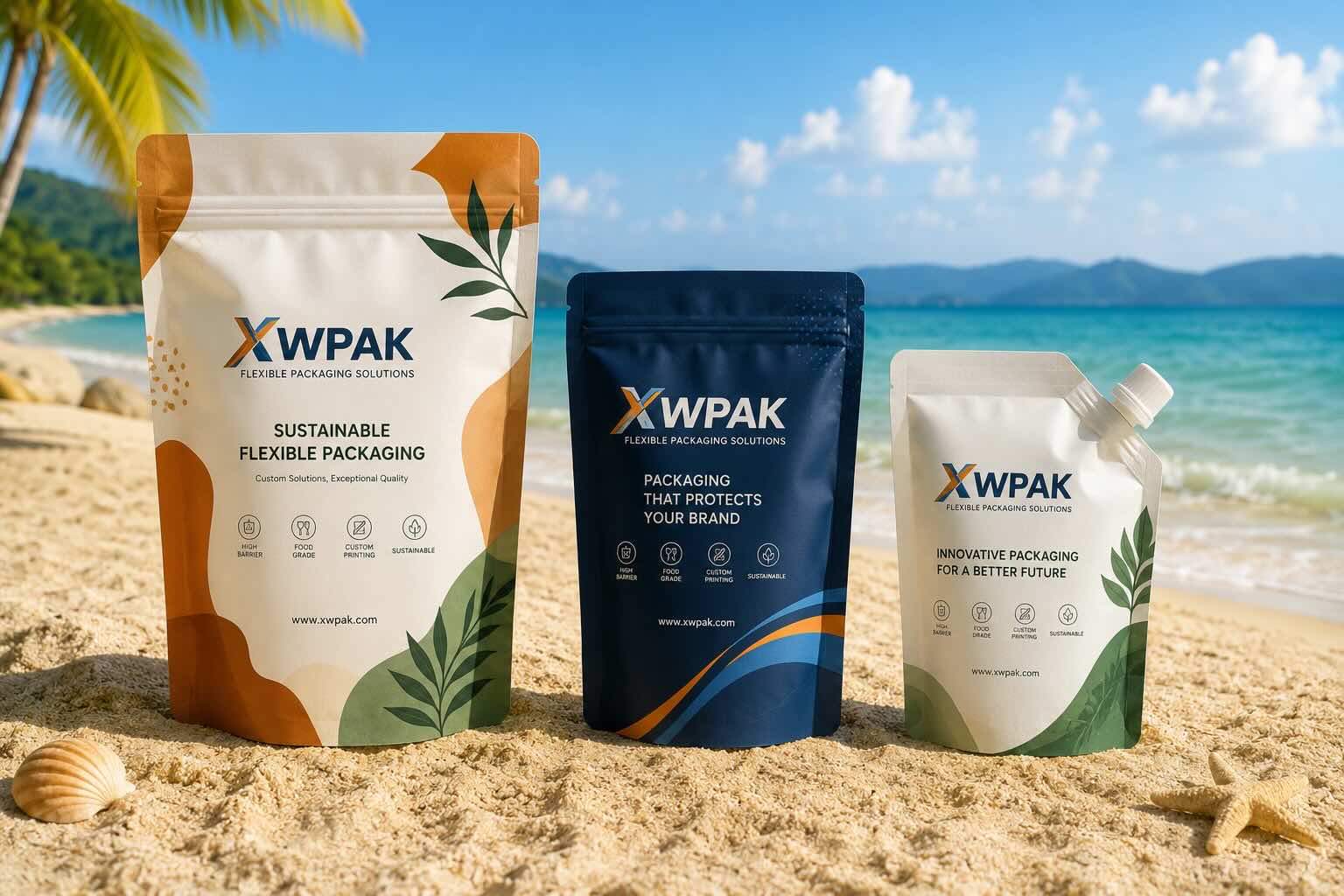
Most coffee bag manufacturers require 5,000-10,000 unit minimums. XWPAK offers 1,000-unit MOQ with identical quality and custom printing
Low MOQ solves the real problem: testing new designs, seasonal blends, or packaging upgrades without betting your cash on unsold inventory
Per-unit cost at 1K is 15-20% higher than 5K, but the risk reduction and faster iteration justify it for growing roasters
Lead time is the same whether you order 1K or 10K. No quality corners cut based on volume
Small-batch roasters can now compete with established brands on packaging without the financial exposure
You roast 500 lbs of coffee per month. You've outgrown the basic kraft bags you started with. Your customers ask why your packaging doesn't match the quality of your roast. You want to upgrade to custom-printed pouches with a professional design, but the moment you call a packaging manufacturer, you hit a wall: 5,000 unit minimum order.
5,000 bags at $2.50 each is $12,500 upfront. You don't know if your customers will prefer the new design. You don't know if the darker color you chose will actually pop on retail shelves. You don't know if the tear-zipper feature customers mentioned will matter. Betting twelve grand on unknowns feels like gambling, not business strategy.
This is the bottleneck that keeps small roasters trapped in commodity packaging or hand-packing. Most of them never upgrade because the MOQ risk is too high. They watch established brands ship bags with custom printing, branded labels, and professional closures while they're still using stock kraft pouches.
The coffee industry created this problem by standardizing high minimums. The assumption was that only large roasters could justify custom packaging. XWPAK flipped that logic: why should a roaster with 500 lbs/month pay the same per-unit premium as one ordering 50,000 lbs? They shouldn't. They should pay a slightly higher unit cost and get the same quality with lower risk.
Key Insight: The 5,000-unit minimum exists because it's profitable for manufacturers, not because your roaster actually needs 5,000 bags. A 1,000-unit MOQ shifts leverage back to you: test packaging, measure customer response, iterate.
The concern is understandable: if a manufacturer accepts 1,000 units instead of 5,000, won't they cut corners? Won't your bags be flimsy, the printing sloppy, the seals weak? The answer is no, if you work with the right partner.
Here's the math: a 1,000-unit order uses the same dies, the same film, the same printing equipment as a 10,000-unit order. The only difference is production run length. A 5,000-unit run might take 8 hours on the production line. A 1,000-unit run takes 1.5-2 hours. The setup time is identical. The quality control checkpoints are identical. The finishing (folding, boxing, shipping) is identical. The cost difference is purely in material and proportional labor, not in cutting standards.
Low MOQ XWPAK
XWPAK's approach: accept the lower MOQ, absorb the slightly higher per-unit cost, and make money on fast turnaround and repeat orders. A roaster who successfully tests 1,000 bags and likes the result usually orders 5,000 the next time. And the time after that. Long-term customer value beats one-time margin on a massive order.
Competitors like Mondi and major industry players built their minimums when small roasters couldn't move volume. They're not optimized for 1K orders; their factories are built for 50K+. They won't negotiate because breaking their standard process costs them efficiency. XWPAK built from the beginning to serve growing roasters, not just established ones.
Here's what you're facing if you call other manufacturers:
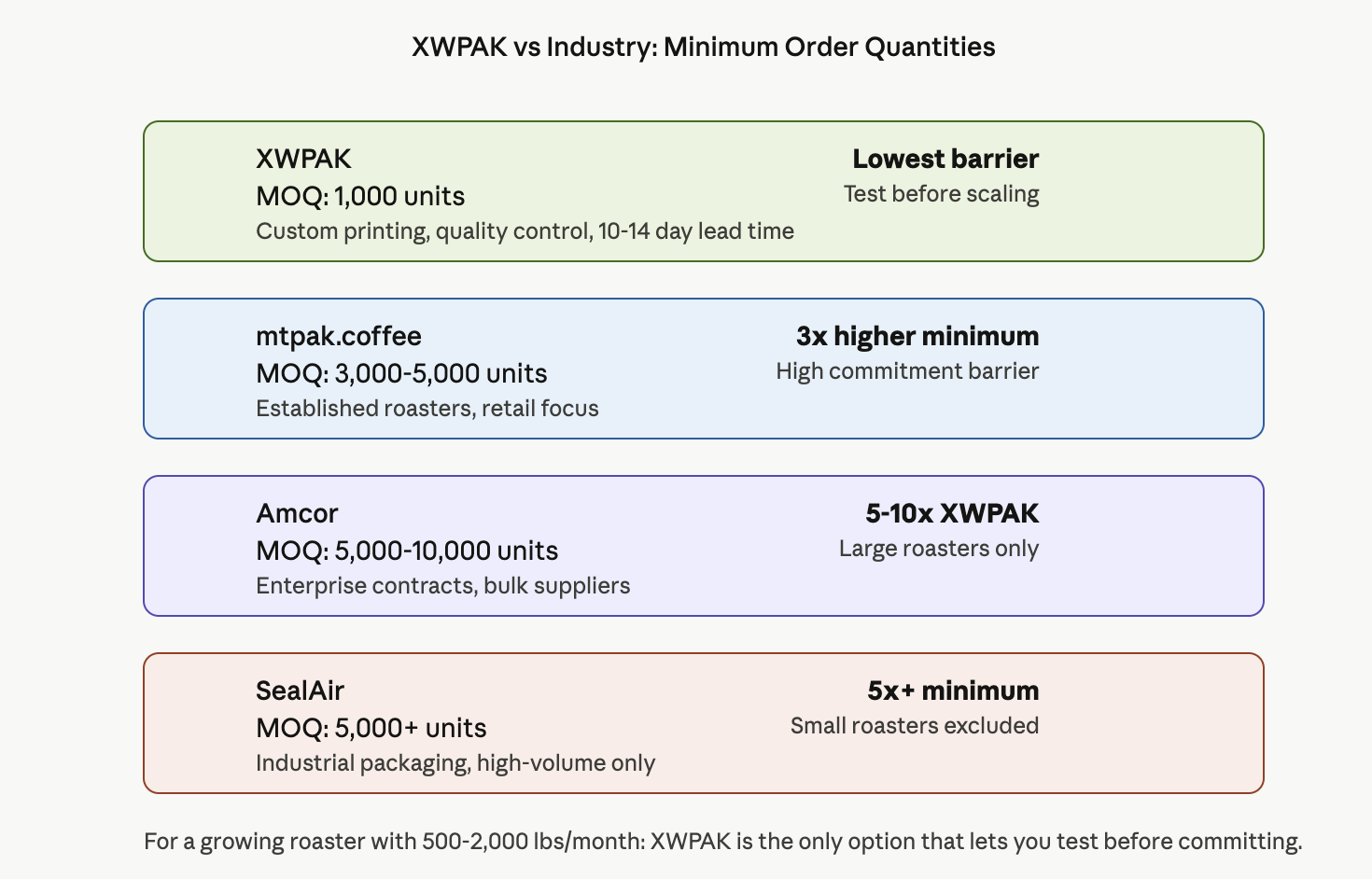
| Manufacturer | Minimum Order Quantity | Market Position |
|---|---|---|
| XWPAK | 1,000 units | Small & big batch roasters, flexible packaging |
| mtpak.coffee | 3,000-5,000 units | Established roasters, retail brands |
| Amcor | 5,000-10,000 units | Large-scale enterprise, commodity volumes |
| SealAir | 5,000+ units | Industrial, high-volume contracts |
| Mondi | 5,000-15,000 units | Global enterprise, established brands only |
XWPAK is the only option in this group that accepts 1,000-unit orders. Everyone else forces you into 3K, 5K, or higher. Prices for custom coffee bags start from $0.20 per unit at scale, but those minimums are 5,000 bags or more.
The gap matters. mtpak.coffee's 3K minimum is still too high for testing. Amcor and SealAir don't even return calls from roasters under 10,000 units monthly. Mondi's enterprise-only focus means you need annual contracts or high-volume commitments. XWPAK exists in the gap that everyone else abandoned: the growing roaster with real quality demands but real budget constraints.
Real Scenario: A roaster tests a new seasonal blend with 1K bags at $2.80/unit. The design and coffee impress customers. They reorder 5K at $2.15/unit. This progression builds confidence and cash flow. The competitor's forced 5K minimum would have delayed the entire decision by 6+ months.
Companies like Mondi, Huhtamaki, and regional competitors with 5,000-10,000 unit minimums are trapped by their own infrastructure. They built factories optimized for large, consistent runs. Their equipment changeover costs are high (die sets, color matching, setup time). Their sales teams are trained to manage enterprise relationships, not hundreds of small roasters. The per-order overhead is proportionally higher for small quantities.
Mondi's solution: raise the minimum to 5,000 and make margin on large orders. mtpak.coffee tried the low MOQ angle but has since moved to 3,000-5,000 minimums as they scaled. The math works for them because they target established brands. For new or growing roasters, they're irrelevant.
XWPAK's approach is different: accept variable production schedules, optimize for speed instead of batch size, and build relationships with roasters as they grow. A 1K MOQ today might become 20K MOQ in three years. That compounding value matters more than maximizing the first order's margin.
1,000 units gives you enough bags to test without risk. Here's how to use it:
Phase 1: Validate Design (500-700 bags)
Ship these bags to your existing customers and monitor feedback. Do they comment on the design? Do they prefer this over your old packaging? Are there complaints about the closure, size, or aesthetics? This data is gold. Most roasters skip this step and order 5,000 blind, then watch sales flatline because the design didn't resonate.
Phase 2: Test New Channels (300-500 bags)
Try selling at a local farmers market or boutique shop. See if customers pick up your coffee because the packaging caught their eye. See if wholesale buyers take you seriously now that you look established. This real-world test costs nothing compared to the learning you gain.
Phase 3: Iterate (Order Again)
Based on feedback, order 3,000-5,000 for full deployment. You know the design works. You know customers like it. You're not guessing anymore. The second order is a scaling decision, not a gamble.
This cycle is impossible with a 5,000-unit minimum. You'd invest $12,500 and hope. With XWPAK's 1K MOQ, you invest $2,800 and know. Then you scale confidently.
XWPAK's quality checklist is identical whether you order 1K or 50K:
Film inspection for defects (holes, thickness variance)
Printing quality check (color accuracy, registration, no ghosting)
Seal integrity testing (strength, moisture resistance)
Valve functionality (if applicable): pressure testing to ensure valves open and close properly
Random sample testing from production (not just first and last bags)
Packaging and shipping inspection
The production run is shorter, but the rigor is the same. You're not getting "testing-phase" bags. You're getting finished product that meets the same specifications as a 50,000-unit order. This is where XWPAK differentiates from fly-by-night suppliers who might offer low MOQs but with quality shortcuts.
Standard lead time for a 1,000-unit custom order is 10-14 days from approval to shipment. This is identical to a 5,000-unit order. You're not paying a speed premium; the timeline is the same. Why? Because setup time (die cutting, color matching, machine configuration) is the bottleneck, not production volume. 1,000 units or 5,000 units take the same setup, so the per-order timeline doesn't change.
Shipping to the US from China typically takes 15-22 days by sea, 5-8 days by air. For a roaster testing 1K bags, air freight often makes sense because the speed justifies the cost (roughly $400-600 for 1K bags). The total project timeline: 2-3 weeks from approval to bags in hand. For a seasonal release or rapid testing cycle, that's tight and workable.
The natural progression is 1K > 3K > 5K. You don't need to jump straight to 5K. Here's how to know when it's time to move up:
Order 3K when:
Your 1K bags are running out within 4-6 weeks
Customer feedback is solidly positive (no design regrets)
You have a confirmed wholesale order or retail shelf placement coming
Order 5K when:
You're roasting 1,000+ lbs per month consistently
Wholesale or subscription revenue is growing predictably
You have 8-12 weeks of usage runway before ordering again
Each jump increases your inventory commitment but gives you economies of scale. Only scale when demand visibility supports it. XWPAK's low MOQ lets you build that visibility safely, step by step.
Setup costs are fixed (dies, color matching, machine configuration). At 1K, those setup costs are spread over fewer units, raising the per-unit cost about 15-20%. At 5K and above, fixed costs are amortized, lowering the per-unit price. This is standard across all manufacturing, not specific to packaging.
No. You submit artwork, XWPAK creates a proof, you approve or request changes, and production begins. Same process, same timeline. Multiple rounds of proofing are included. This ensures your low-volume order gets the quality-control attention it deserves.
Mixing increases setup time and complexity. For a 1K order, a single size and style is standard. If you want 500 units of 8oz and 500 of 1lb, XWPAK can accommodate it, but expect a lead time extension (1-2 weeks longer) and a small upcharge. Keep your first order consistent for fastest delivery.
You can design-change and reorder within 5-7 days. The dies from your first run can be adjusted or remade. It's faster and cheaper than starting a completely new project. This flexibility is one of the biggest advantages of working with a low-MOQ partner.
No. Each custom order gets its own production run, dies, and quality checks. Your 1K bags aren't mixed with anyone else's. You get 100% of a production session dedicated to your specs. This is standard practice and ensures consistency.
XWPAK's 1,000-unit minimum lets you upgrade your packaging, test customer response, and scale confidently. Start with a single design, measure results, then grow.
Request a Quote