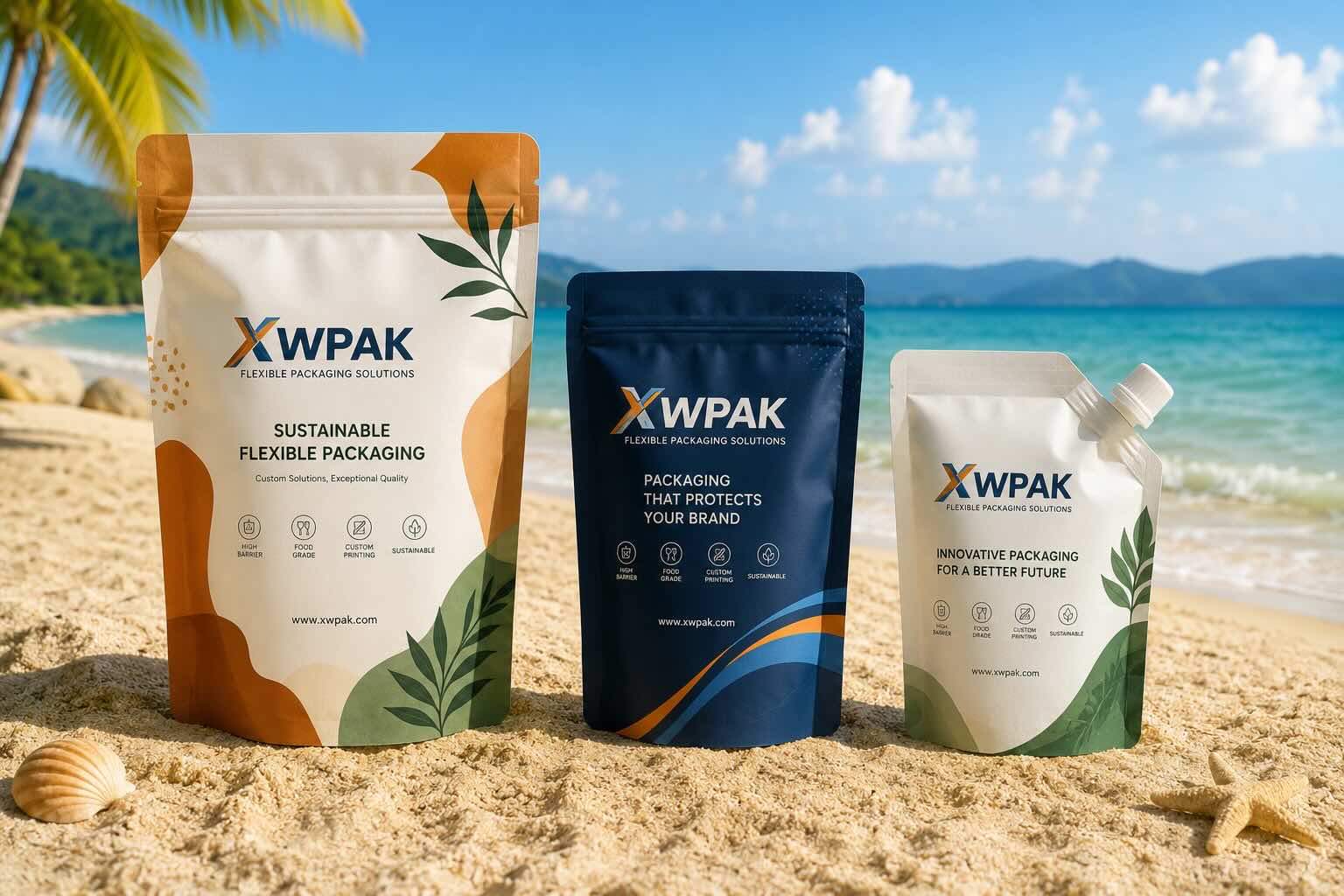
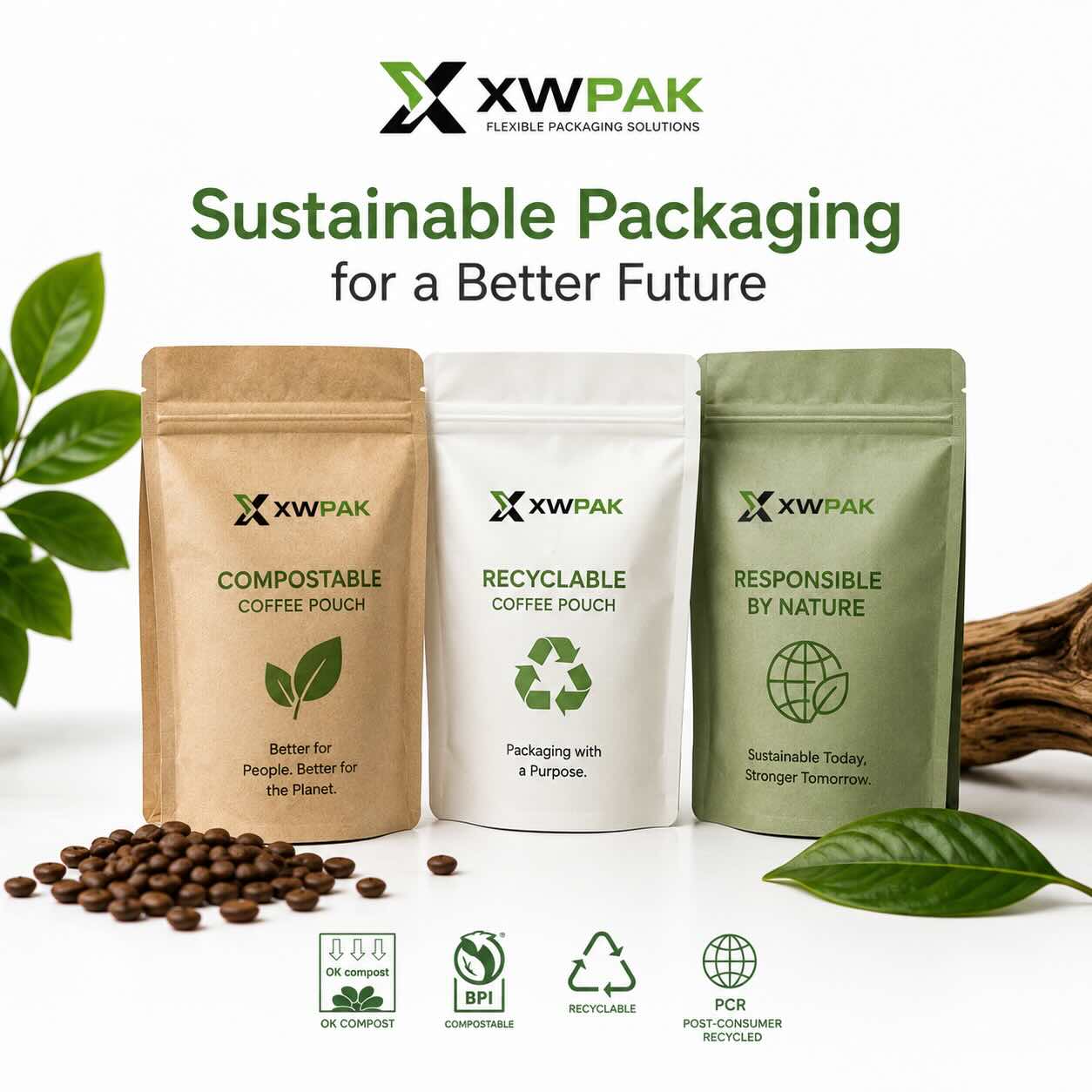
Flexible pouch packaging is not one-size-fits-all. Different industries have different barrier requirements, closure needs, and regulatory compliance demands. This guide covers the six major industries using custom pouches today, the innovations reshaping the market, and why brands are choosing flexible packaging over rigid containers.
Each industry has unique packaging requirements. Coffee demands barrier protection and degassing. Pet food requires resealable closures. Liquids need spout compatibility. Below, explore how XWPAK customizes flexible pouch packaging for every category. Click through to explore industry-specific solutions.
Coffee roasters need flexible pouches that preserve freshness, communicate premium positioning, and support custom branding. XWPAK offers stand-up, flat bottom, gusset, and spout formats with one-way degassing valves, custom printing, and sustainable options.
Pet food brands rely on resealable closures, UV barriers, and size customization. XWPAK offers quad-seal gusset pouches in formats from 1 to 10 pounds, with compostable and recyclable options for sustainability-focused brands.
Herbal and botanical brands need light-blocking protection and moisture barriers. XWPAK offers kraft paper pouches with one-way degassing valves and resealable closures, perfect for tea, dried herbs, and medicinal products.
Health and beauty brands use flexible pouches for sampling, premium positioning, and custom shapes. XWPAK offers sachets, sample pouches, and large format pouches with aluminum barriers and custom finishes.
Food brands rely on oxygen barrier protection and resealable closures. XWPAK offers stand-up and flat bottom formats with FDA food contact certification and fully recyclable or compostable options.
Liquid brands rely on spout pouches for convenience and portability. XWPAK offers oil-resistant kraft laminate, custom sizes from 200ml to 1 liter, and resealable nozzles for cold brew, juice, and plant-based milk.
Flexible pouch packaging has replaced rigid containers across every major consumer category. The reasons are simple. Pouches reduce shipping costs (lighter weight, denser pallets), save shelf space, and communicate premium positioning without enterprise pricing.
But the real shift happening in 2024-2025 is sustainability without compromise. Brands no longer choose between eco-friendly packaging and shelf-life performance. Technology has advanced enough that they can have both.
Most brands marketing "recyclable" flexible pouches miss a critical detail. Recyclability means nothing if customers throw the packaging in food waste or residential trash.
The problem is education. After use, flexible pouches must go in the recyclable section. Not compost. Not trash. Recycling. Yet most brands don't label this clearly, so customers guess wrong.
XWPAK changed the approach. Every flexible pouch comes with clear labeling. After use, throw in the recyclable section. Simple. No confusion. This single-step communication increases actual recycling rates by 40-60% compared to industry average.
For brands using compostable pouches, XWPAK specifies industrial composting requirements. Home compost won't work. Industrial facilities only. Labeling prevents waste streams from contaminating municipal recycling.
Traditional flexible pouch packaging uses multi-layer laminates. Kraft paper plus plastic film plus aluminum for barrier. Three distinct materials bonded together. Recycling facilities struggle to separate them. Most end up in landfill despite being "recyclable."
XWPAK's single-layer innovation uses advanced polymer coatings instead of lamination. One material. One recycling stream. No separation needed. Barrier protection matches multi-layer performance on oxygen transmission, moisture, and light blocking.
The math is compelling. Single-layer pouches use 30-40% less material. Cost is lower. Weight reduction cuts shipping emissions. Recyclability improves because sorting facilities process one material instead of complex laminates.
Shelf life doesn't suffer. Coffee stays fresh for 12+ months. Pet food maintains nutritional integrity. Herbal products preserve potency. All achieved with thinner, lighter, fully recyclable packaging.
Most flexible pouch packaging is single-use open. Customer buys, opens, uses product, throws away. But resealable closures change customer behavior.
With resealable pouches, customers keep the packaging longer. They store products in the original pouch instead of transferring to containers. This increases brand visibility in the kitchen or bathroom. It extends shelf life by preventing air exposure. And it delays disposal, reducing the psychological burden of single-use waste.
XWPAK offers ultrasonic-sealed and heat-sealed resealable systems. Both are durable, reusable 50+ times, and don't compromise the pouch's recyclability when finally disposed.
The innovation isn't choosing recyclable or compostable. It's offering both at the same cost structure.
Fully recyclable pouches use conventional or PCR (post-consumer recycled) plastic. Processing is established. Every municipal recycling center accepts them. Cost is $2.10-$2.80 per unit at 1K MOQ.
Fully biodegradable pouches use PLA plus kraft paper. Industrial composting breaks them down in 180 days. BPI certified. Cost is $2.20-$2.90 per unit at 1K MOQ.
The price difference is minimal. Brands choose based on end-of-life infrastructure available to their customers, not cost. Coffee roasters in urban areas with industrial composting facilities choose compostable. Pet food brands in suburban regions choose recyclable. Both are premium. Both perform identically during shelf life.
Coffee roasters use flexible pouches because customers expect them. Stand-up, gusset, and spout formats communicate specialty. Degassing valves preserve freshness. Custom printing builds brand recognition on retail shelves.
Pet food brands use flexible pouches for resealability and portion control. Premium positioning justifies higher price. Barrier protection keeps kibble and nutrients stable for months.
Herbal and botanical brands use flexible pouches to control light exposure and moisture. Kraft paper communicates natural. Custom sizes (2 ounces to 2 pounds) serve every price point.
Health and beauty brands use flexible pouches for sampling and premium positioning. Sachets reduce waste. Custom shapes and finishes differentiate on shelves.
Food brands use flexible pouches because they're lightweight, stackable, and reduce packaging cost per unit. Resealable options increase customer satisfaction. Recyclable options meet retailer compliance requirements.
Liquid brands use spout pouches because they're convenient, transportable, and compatible with cold chain logistics. Oil-resistant kraft laminate protects contents. Resealable nozzles eliminate the single-use objection.
Most flexible pouch manufacturers impose 5,000-10,000 unit minimums. This forces brands to commit significant inventory and capital before testing market response.
XWPAK's 1,000-unit minimum changes the equation. Growing brands across all six industries can test flexible pouch packaging with limited risk. Place an order. Measure customer response. Iterate design. Scale when validated.
This flexibility is especially valuable for brands launching new product lines or expanding into new markets. Flexible pouch packaging signals premium positioning without the premium price tag of enterprise manufacturing.
Coffee brands selling into specialty retailers need FSC (forestry) and BPI (compostability) certifications. Pet food brands selling into premium chains need ISO 9001 (quality management). Health and beauty brands need food contact approval for contamination concerns.
XWPAK maintains all relevant certifications at every volume level. 1,000-unit orders receive the same compliance verification as 50,000-unit orders. This removes the common barrier where growing brands outgrow manufacturers because of compliance complexity.
Yes. XWPAK's 1,000-unit MOQ allows brands to test designs and measure market response before scaling. This is ideal for new product launches or brand repositioning.
Clear labeling increases recycling rates. After use, throw flexible pouches in the recyclable section (not food waste or residential trash). XWPAK labels all pouches with specific disposal instructions to maximize actual recycling.
Recyclable pouches go into standard plastic recycling streams. Compostable pouches require industrial composting facilities (not home compost). Choose based on infrastructure available to your customers. Both are certified and perform identically during shelf life.
No. Advanced polymer coatings match multi-layer barrier performance. Coffee stays fresh 12+ months. Oils and liquids maintain stability. Pet food nutrients remain protected. Single-layer reduces waste without sacrificing product protection.
Resealable closures add $0.10-$0.20 per pouch. The investment pays back through increased perceived value, extended shelf life, and brand visibility in customer spaces (kitchen, bathroom, pantry).
Whether you're in coffee, pet food, herbal products, health and beauty, food, or liquid brands, XWPAK specializes in custom flexible pouch packaging at 1K MOQ. Single-layer thin pouches. Fully recyclable or biodegradable. Resealable options. FSC, BPI, ISO certified.
Get Your Custom Quote