Quick Read: XWPAK's PCR laminated bags have cleared five independent food contact migration tests conducted by TUV Rheinland, covering global migration, heavy metals, phthalates, primary aromatic amines, and bisphenols including BPA. All five test reports returned not detected across every hazardous substance category, and TUV Rheinland issued a formal Attestation of Conformity confirming compliance with EU Regulation No. 10/2011 and its 2024/2025 amendments for the German market. This places XWPAK among a small number of flexible packaging manufacturers in China that have subjected their recycled-content laminate structures to this level of independent chemical scrutiny.
PCR laminated bags, meaning bags made with post-consumer recycled content laminated into a multi-layer structure, present a more complex food safety challenge than virgin material bags. Recycled content introduces variability in the base polymer, and lamination adhesives add another potential migration pathway. The EU's food contact plastics regulation, Regulation No. 10/2011, sets specific migration limits precisely because of these risks. Getting a PCR laminate to pass not one but five separate migration tests, conducted by an accredited third-party lab, is not a checkbox exercise. It requires a film structure that is genuinely clean at the molecular level when in contact with food simulants over ten days at 40 degrees Celsius.
Before getting into each individual test, it is worth understanding what the Attestation of Conformity (TUV Reference No. P02452378) represents. This is not a test report. It is the formal declaration issued by TUV Rheinland after reviewing all five underlying test reports and confirming that XWPAK's PCR laminated bags meet all applicable legal requirements for the German market under EU food contact regulations. The document was signed by a Senior Project Engineer at TUV Rheinland's Suzhou chemical laboratory and issued on June 17, 2026. It covers all five test categories simultaneously and is the single document that functions as supplier compliance evidence in a buyer's quality file.
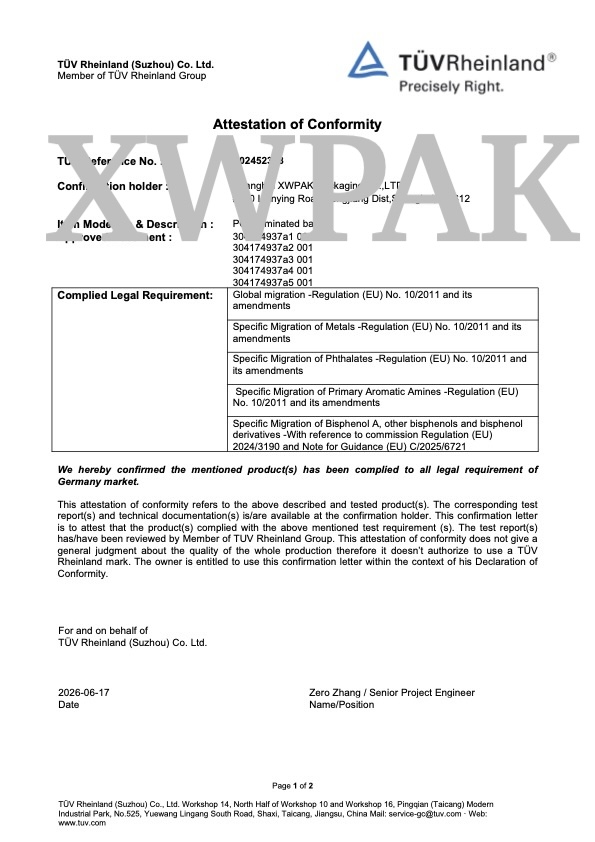 AOC - Page 1 | 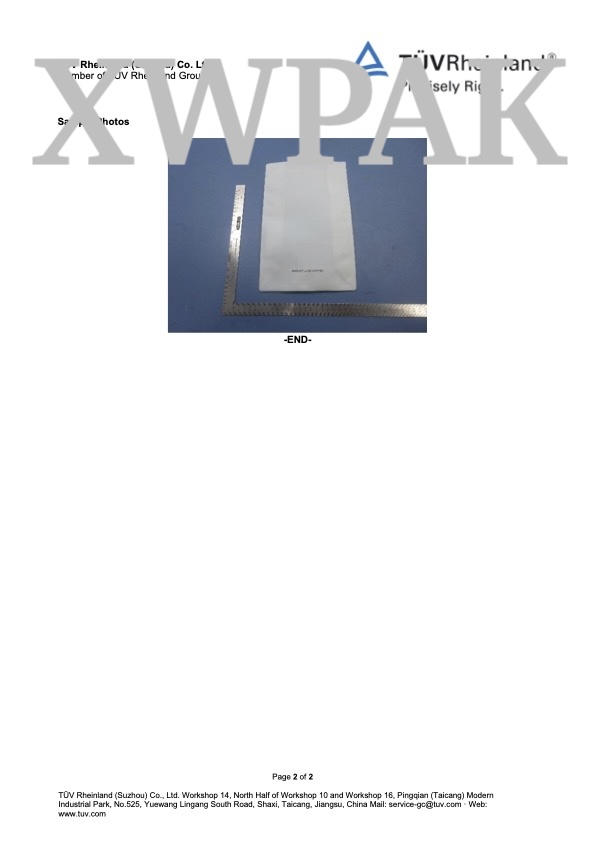 AOC - Page 2 |
TUV Rheinland Attestation of Conformity (Ref. P02452378) issued June 17, 2026, confirming XWPAK's PCR laminated bags comply with EU food contact law for the German market.
Test Report 304174937a1. This is the broadest safety test in the EU framework. It measures the total amount of material transferring from the packaging into distilled water as a food simulant, expressed in milligrams per square decimetre. The regulatory limit is 10 mg/dm2. XWPAK's PCR laminate came in below the reporting limit of 2 mg/dm2, meaning the result was not just compliant, it was effectively undetectable. This matters because global migration is the first filter. If a material fails here, nothing else is relevant. The test ran for 10 days at 40 degrees Celsius at a migration ratio of 200 ml per 1.20 dm2, matching EU worst-case contact conditions for food packaging.
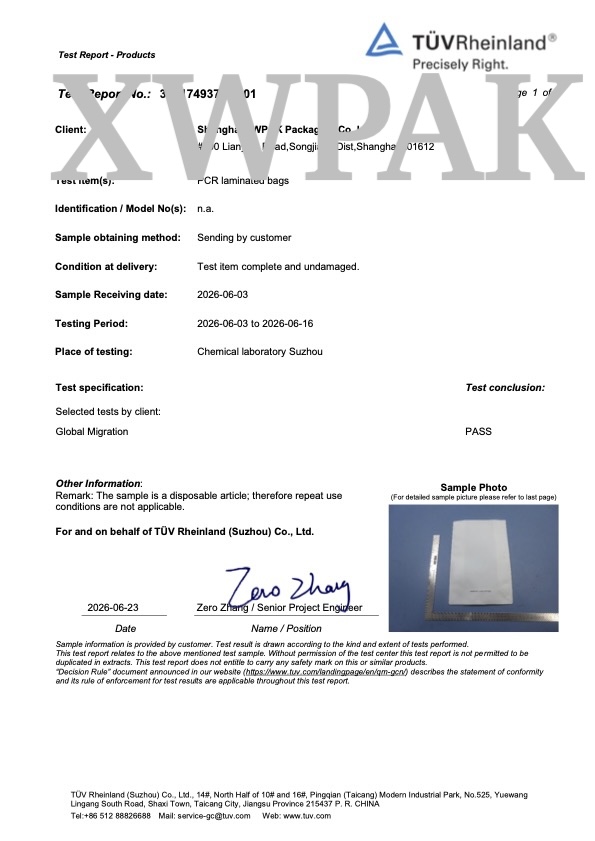 Test Report - Page 1 | 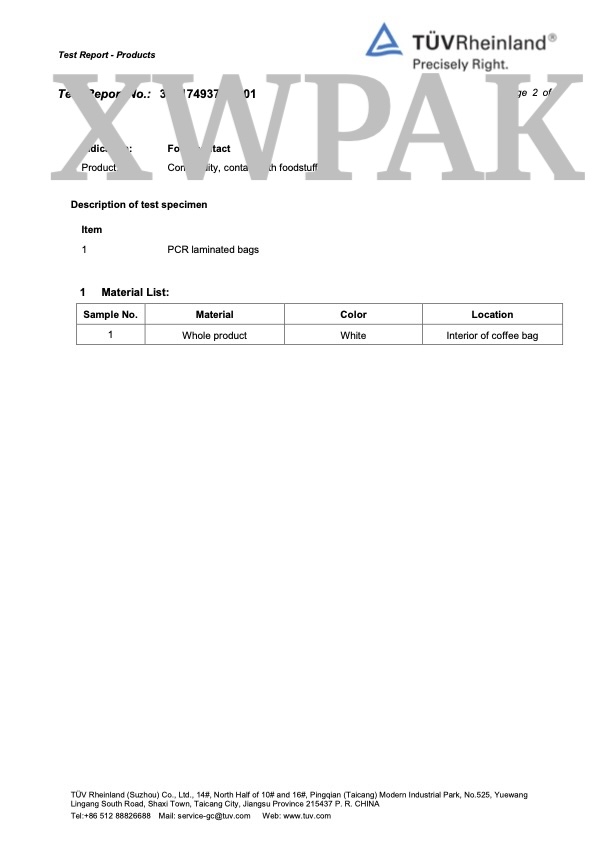 Specimen - Page 2 | 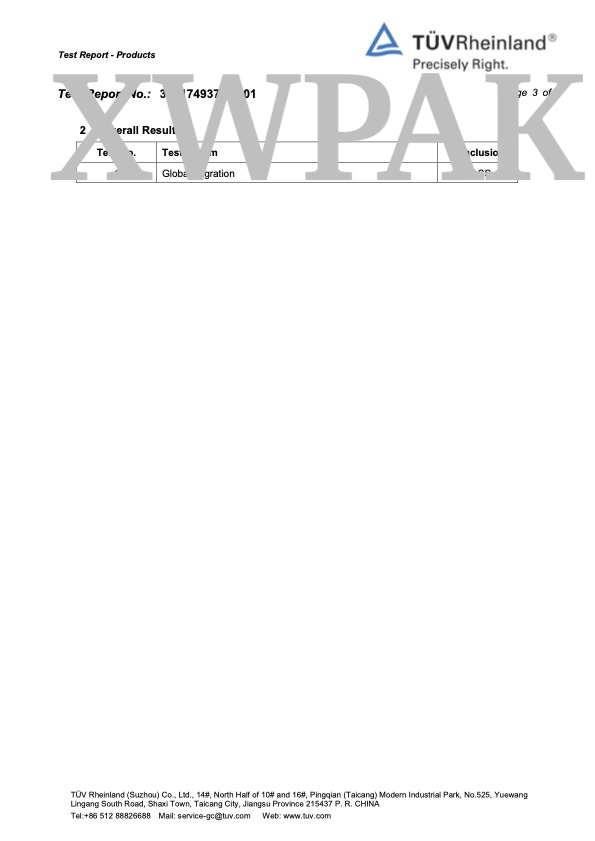 Result: PASS - Page 3 |
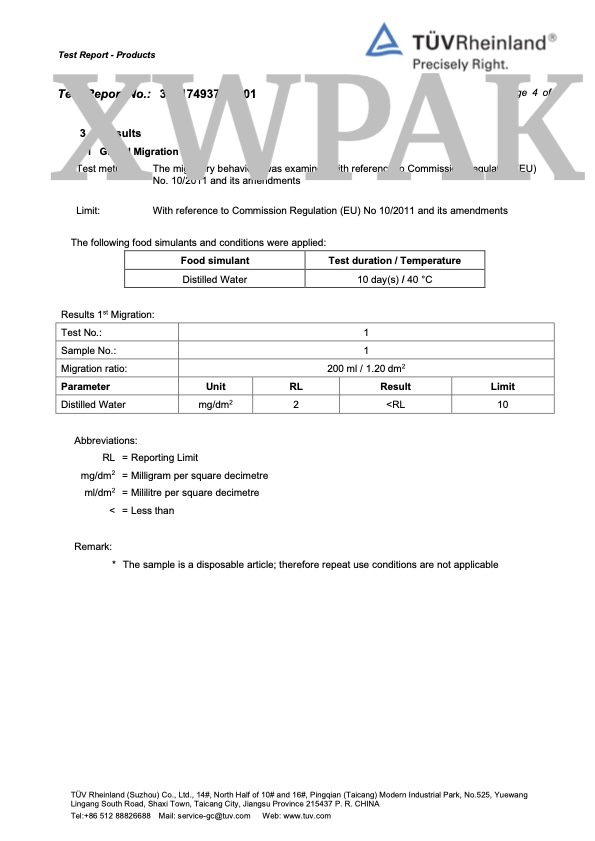 Detailed Results - Page 4 | 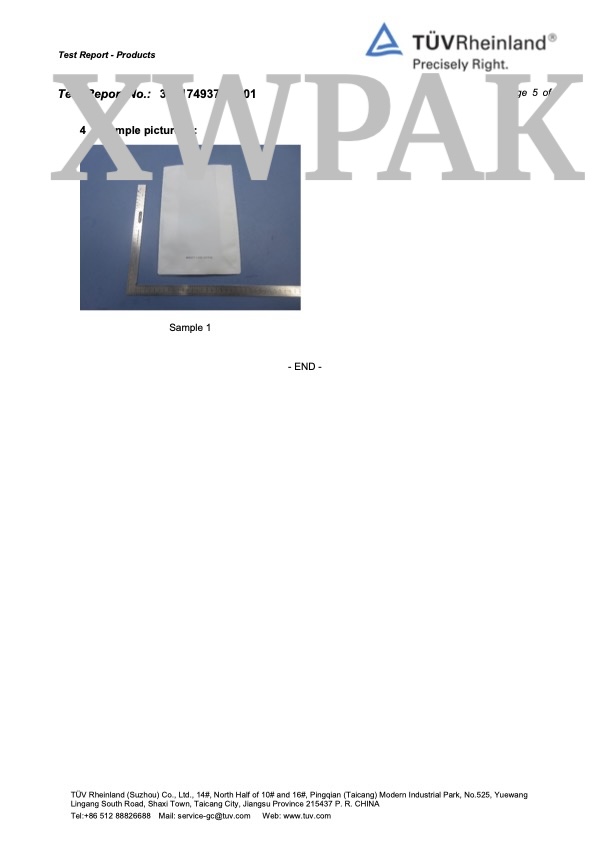 Sample Photo - Page 5 |  Terms - Page 6 |
Test Report 304174937a1: Global Migration on XWPAK PCR laminated bags. Result below reporting limit (less than 2 mg/dm2) vs 10 mg/dm2 EU limit. PASS.
Test Report 304174937a2. This test covers 19 individual metals including aluminium, antimony, arsenic, barium, cadmium, total chromium, cobalt, copper, iron, lead, lithium, manganese, mercury, nickel, zinc, and four lanthanide substances. Every single one returned not detected using ICP-MS analysis, which is one of the most sensitive elemental detection methods available. For brands selling coffee or food products into the EU or UK, lead and cadmium are zero-tolerance substances under the regulation. Arsenic, mercury, and total chromium also carry no detectable limit under EU 10/2011, meaning any measurable migration constitutes a failure. The fact that the entire 19-element metals panel cleared at this level is meaningful for any buyer whose product makes contact with the interior of this bag.
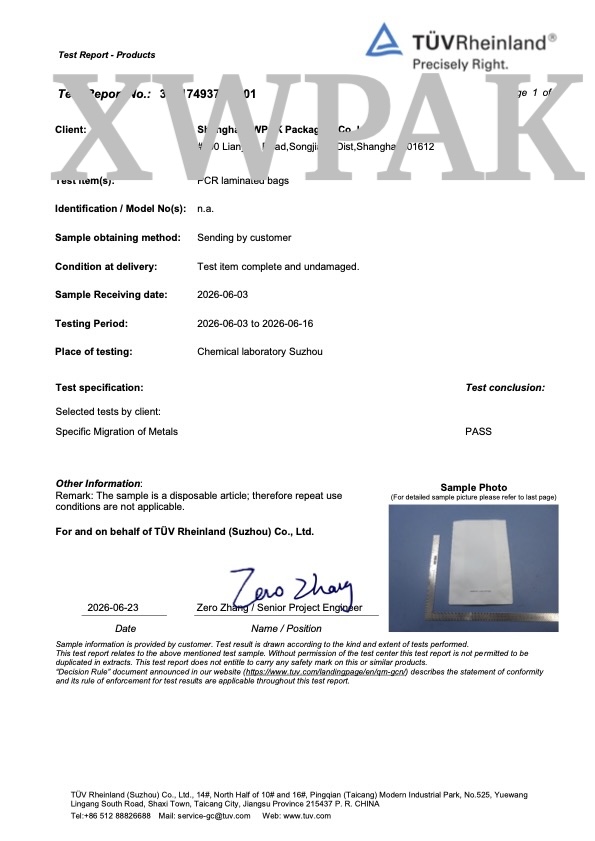 Test Report - Page 1 | 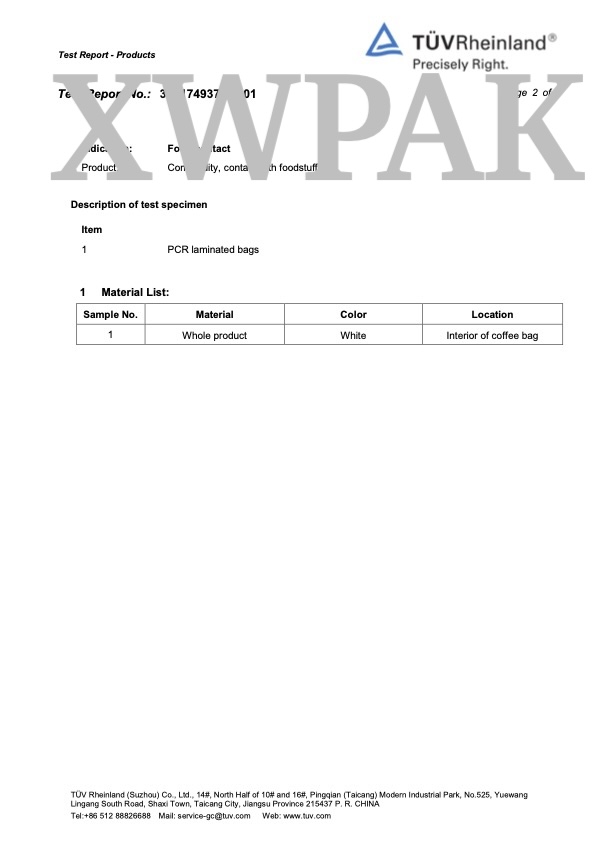 Specimen - Page 2 | 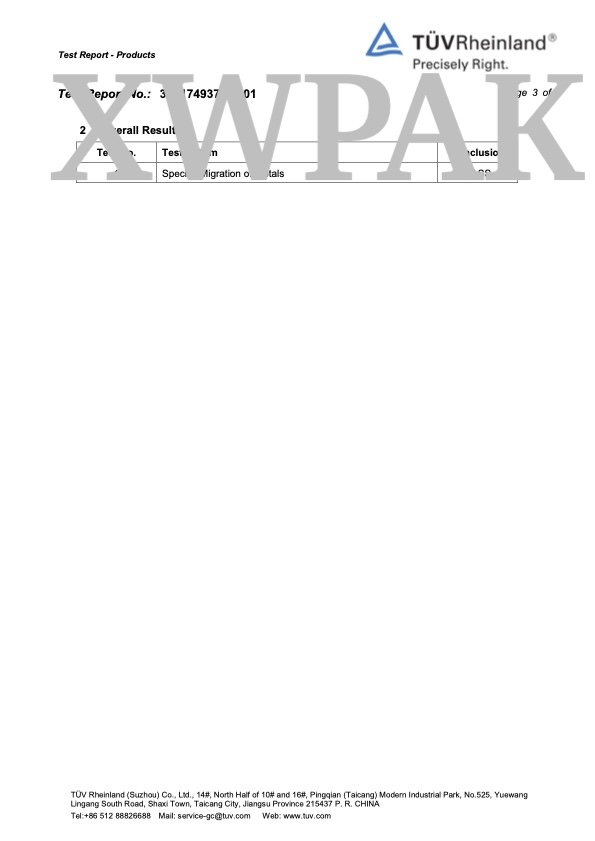 Result: PASS - Page 3 |
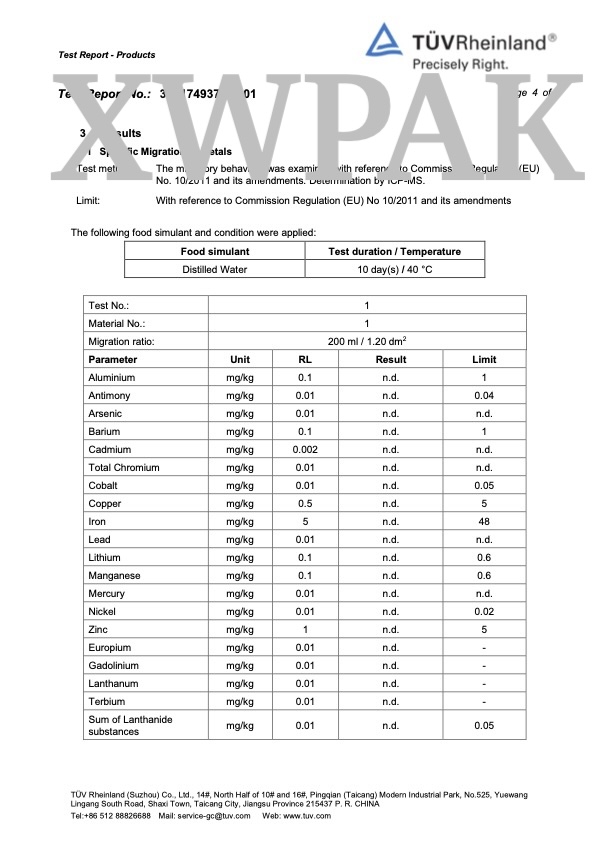 ICP-MS Results - Page 4 | 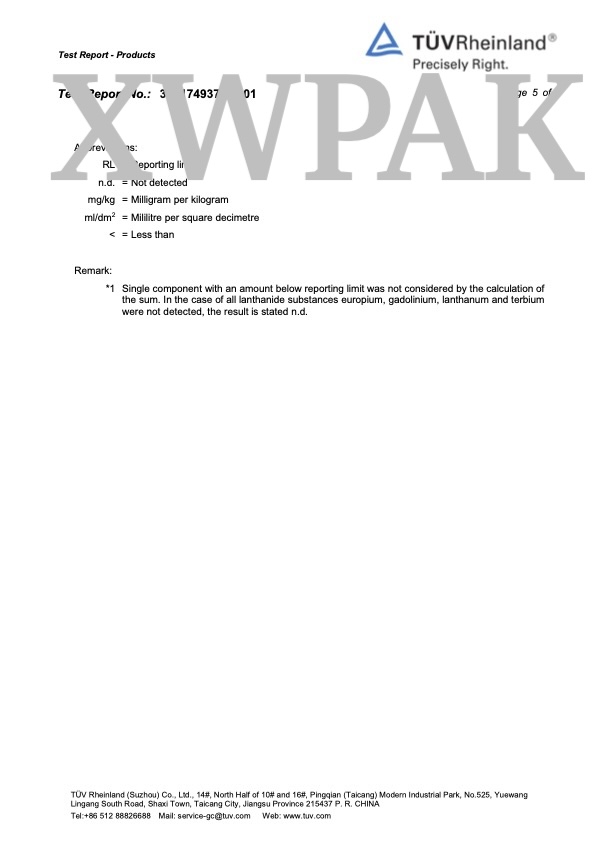 Remarks - Page 5 | 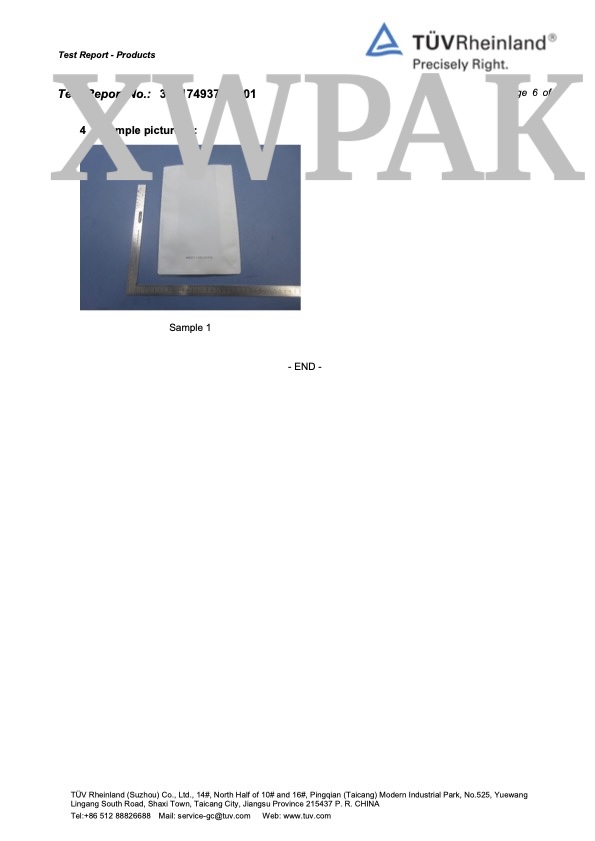 Sample Photo - Page 6 |
 Terms - Page 7 |
Test Report 304174937a2: Specific Migration of Metals via ICP-MS. All 19 elements including lead, cadmium, arsenic, and mercury not detected. PASS.
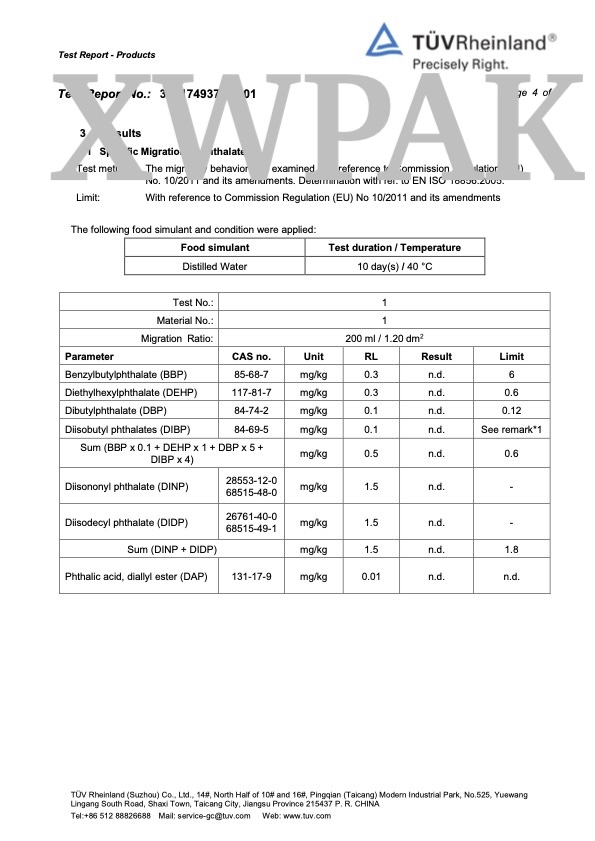
Test Report 304174937a3. Phthalates are plasticizers commonly used in flexible film manufacturing to improve softness and workability. Several of them, particularly DEHP, DBP, and BBP, are classified as substances of very high concern under EU chemical regulation because of their endocrine-disrupting properties. XWPAK's laminate showed not detected across all tested phthalate compounds including the combined sum formula that the EU uses to capture cumulative exposure. For a PCR laminate specifically, this result is significant. Recycled polymer streams can carry residual plasticizers from the previous product life of the recycled material. A clean phthalates result on a PCR structure is not automatic and reflects upstream material control that not every supplier exercises.
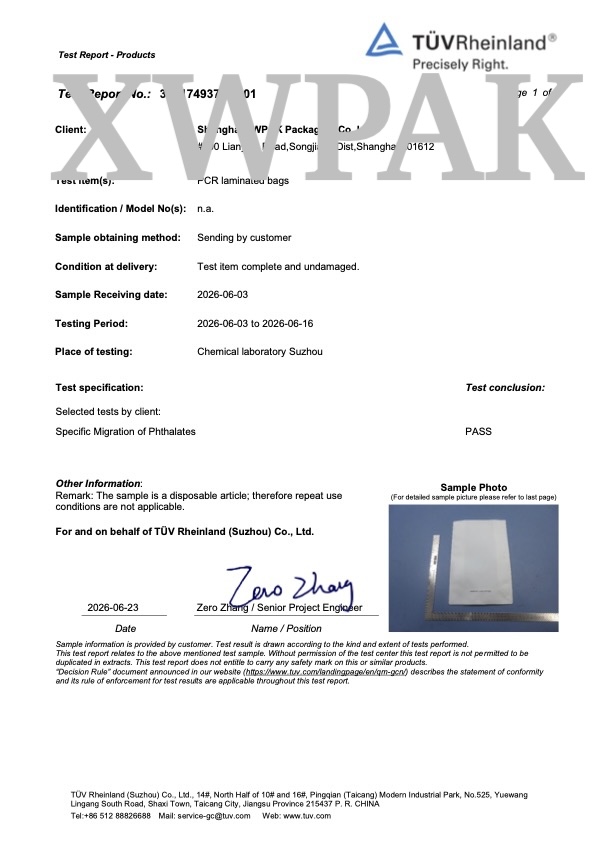 Test Report - Page 1 | 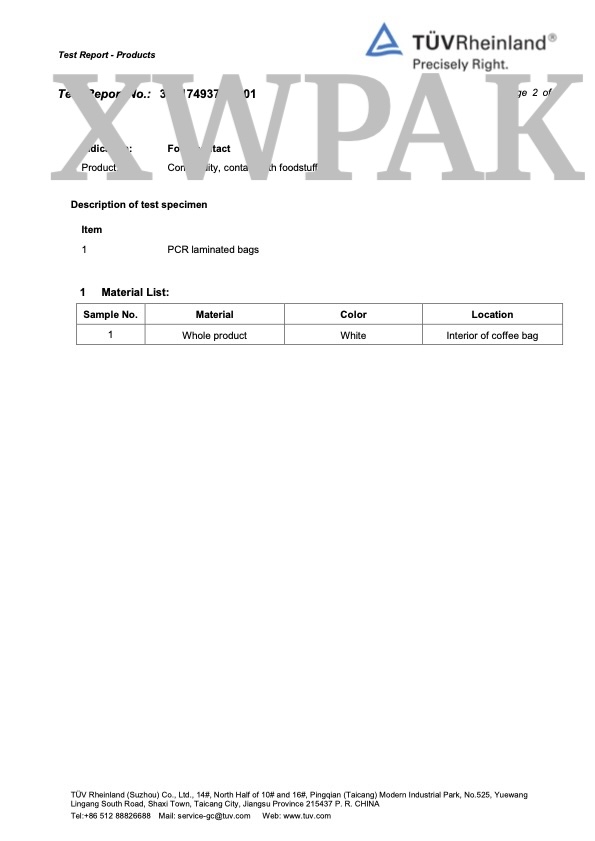 Specimen - Page 2 | 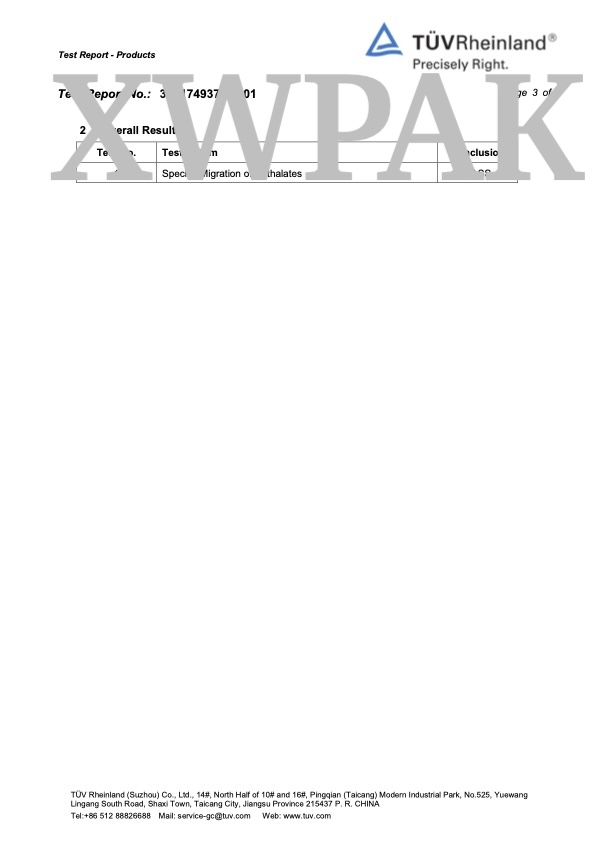 Result: PASS - Page 3 |
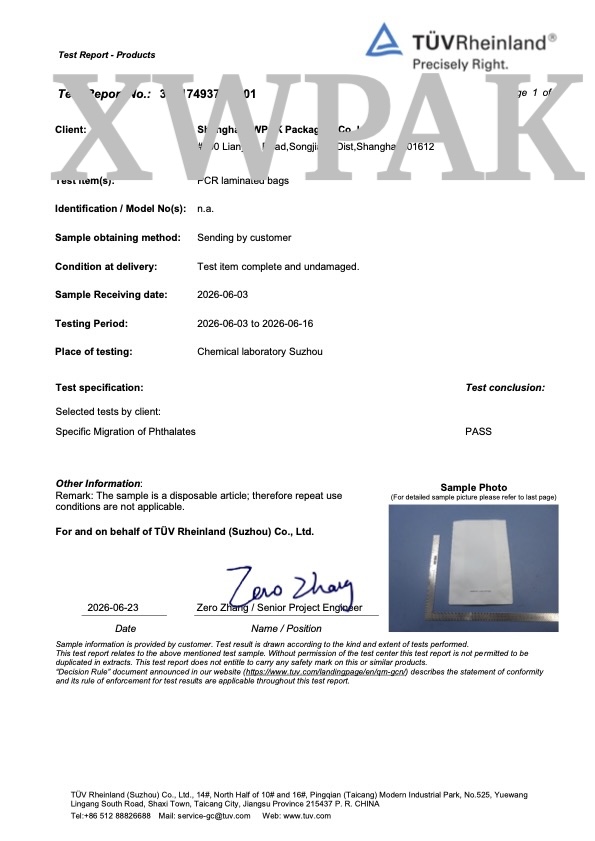 Detailed Results - Page 4 | 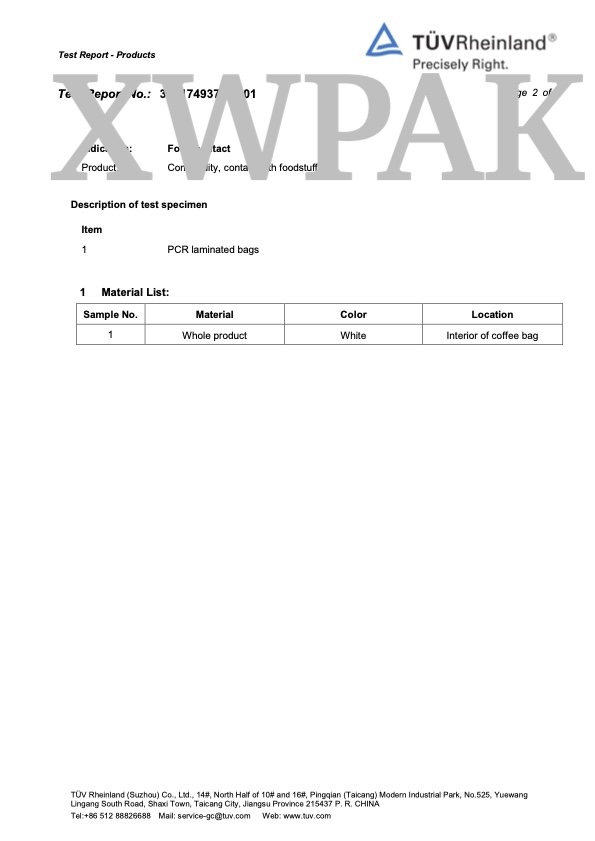 Remarks - Page 5 | 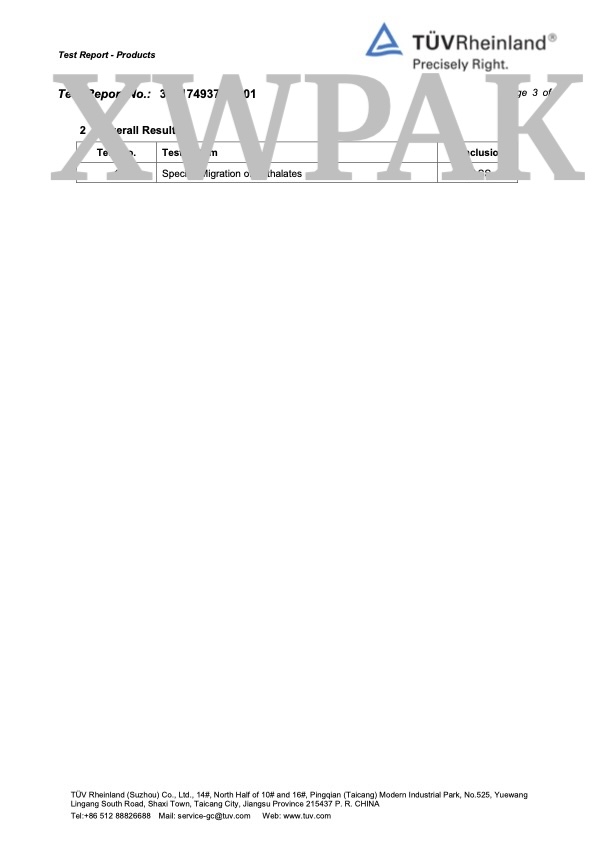 Sample Photo - Page 6 |
 Terms - Page 7 |
Test Report 304174937a3: Specific Migration of Phthalates. DEHP, DBP, BBP, DINP, DIDP, and DAP all not detected. Combined sum not detected. PASS.
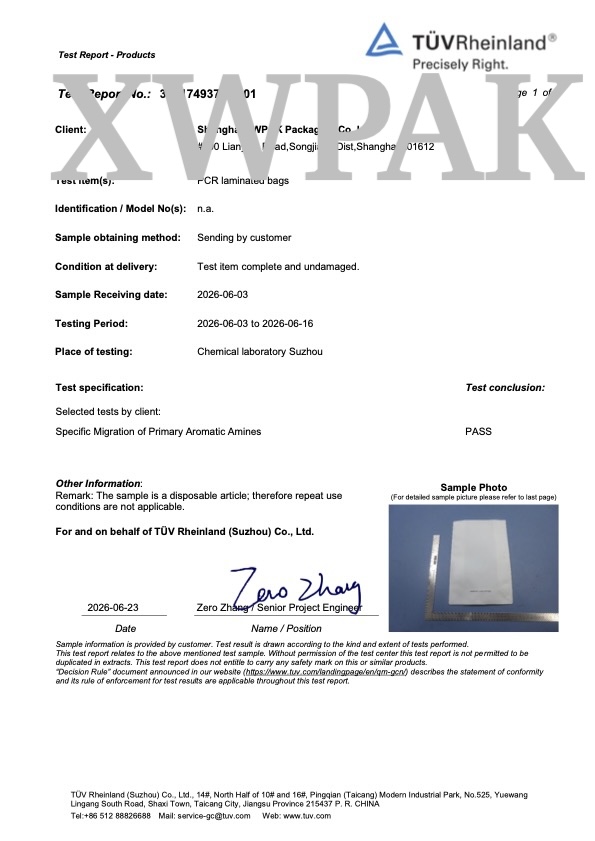
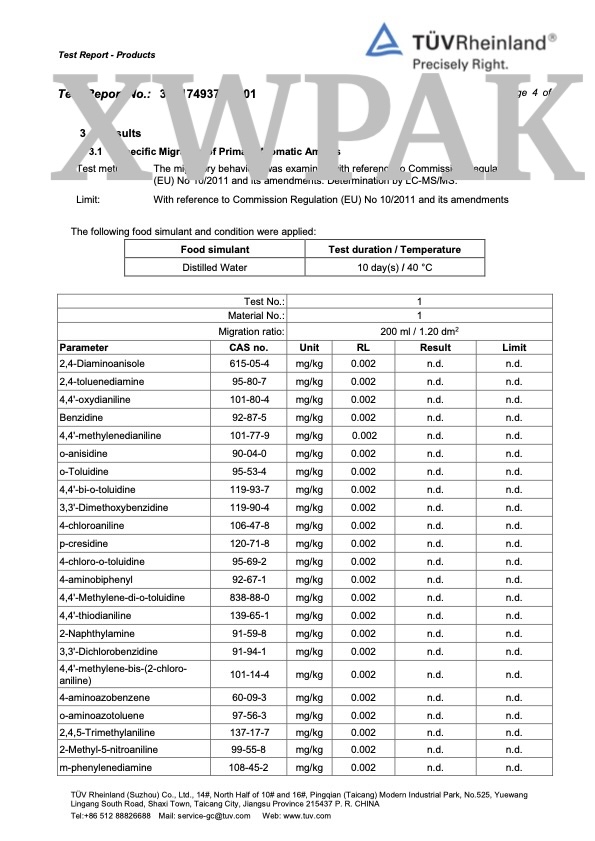
Test Report 304174937a4. PAAs are one of the more technically demanding categories in food contact testing. They can originate from adhesive systems, inks, or degradation products within the laminate structure, and several of them are classified as carcinogenic. TUV Rheinland screened for over 50 individual PAA compounds using LC-MS/MS analysis. Every compound returned not detected, including the regulated sum. For a laminated bag with multiple bonded layers, this result speaks directly to the quality of the adhesive system and the absence of azo dye contamination in the substrate. The breadth of the PAA panel here goes well beyond what many suppliers test, covering both the regulated list under EU 10/2011 Annex XVII and additional compounds not currently on the EU authorization list.
 Test Report - Page 1 | 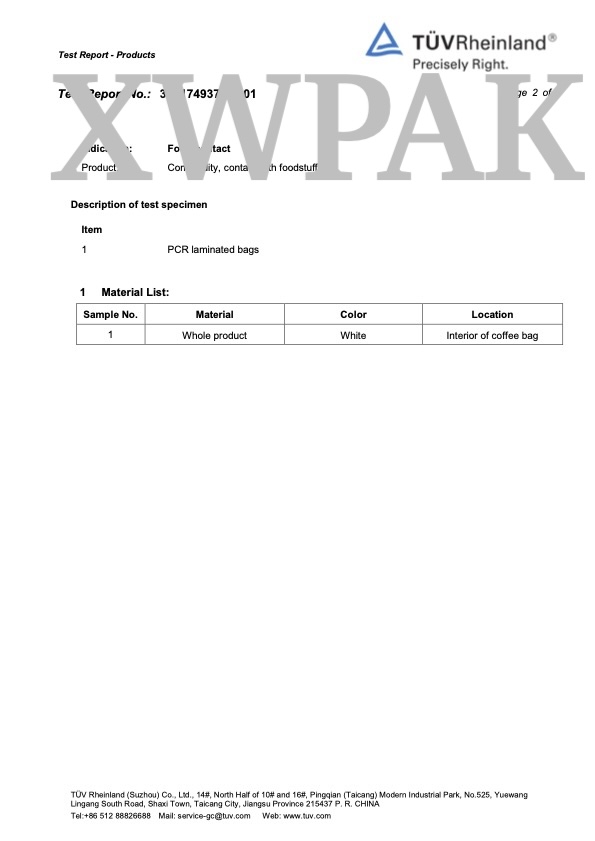 Specimen - Page 2 | 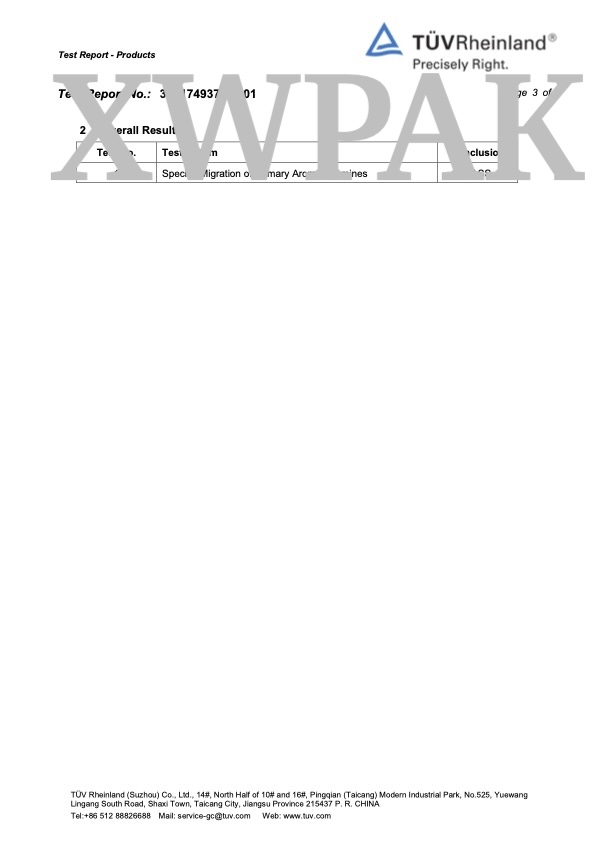 Result: PASS - Page 3 |
 LC-MS/MS Results - Page 4 | 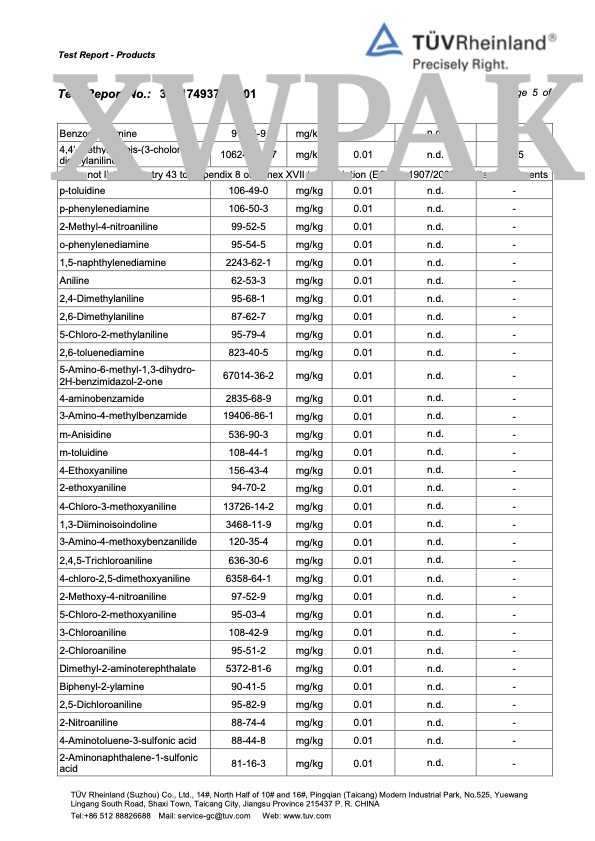 Extended List - Page 5 | 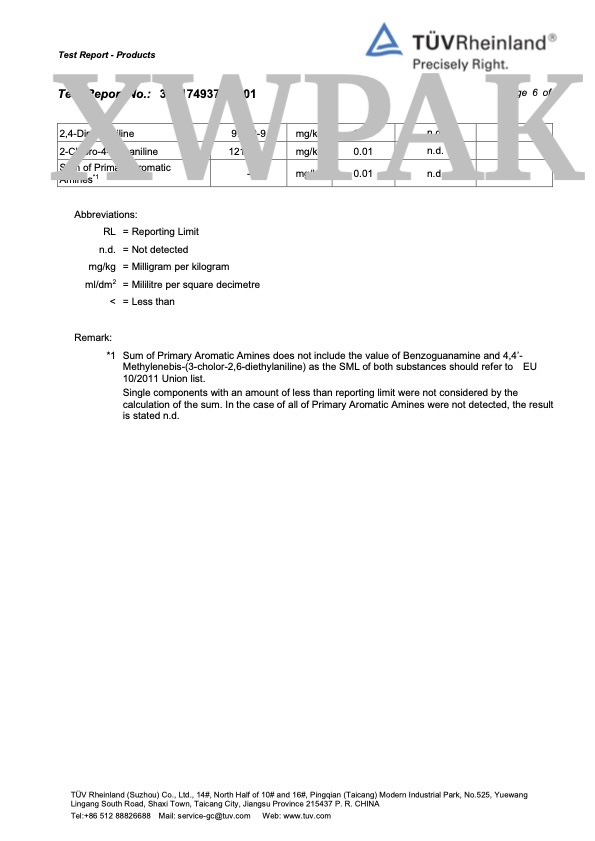 Sum Results - Page 6 |
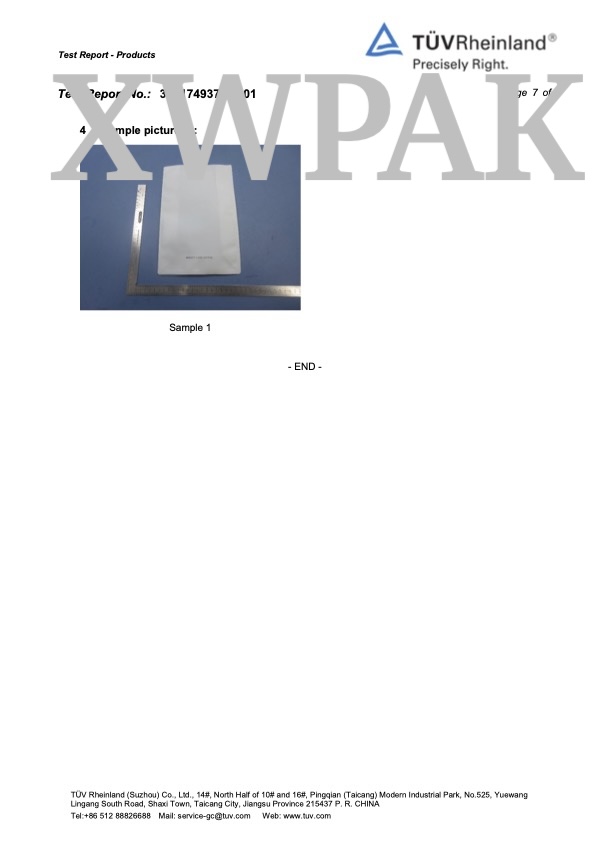 Sample Photo - Page 7 |  Terms - Page 8 |
Test Report 304174937a4: Specific Migration of Primary Aromatic Amines via LC-MS/MS. Over 50 compounds including carcinogenic PAAs returned not detected. Sum not detected. PASS.
Test Report 304174937a5. This is the newest category in the EU framework. Commission Regulation 2024/3190 and the accompanying Note for Guidance C/2025/6721 introduced updated requirements for bisphenol migration testing, covering not just BPA but seven related compounds including Bisphenol S, Bisphenol F, Bisphenol AF, Bisphenol B, TBBPA, and Phenolphthalein. All eight compounds returned not detected via LC-MS/MS analysis. BPA migration has become both a regulatory and a consumer-facing concern. Brands using packaging with a clean bisphenol panel from a third-party lab are in a stronger position commercially, particularly with retailers in Europe and North America who are now actively requesting bisphenol-free documentation as part of supplier onboarding.
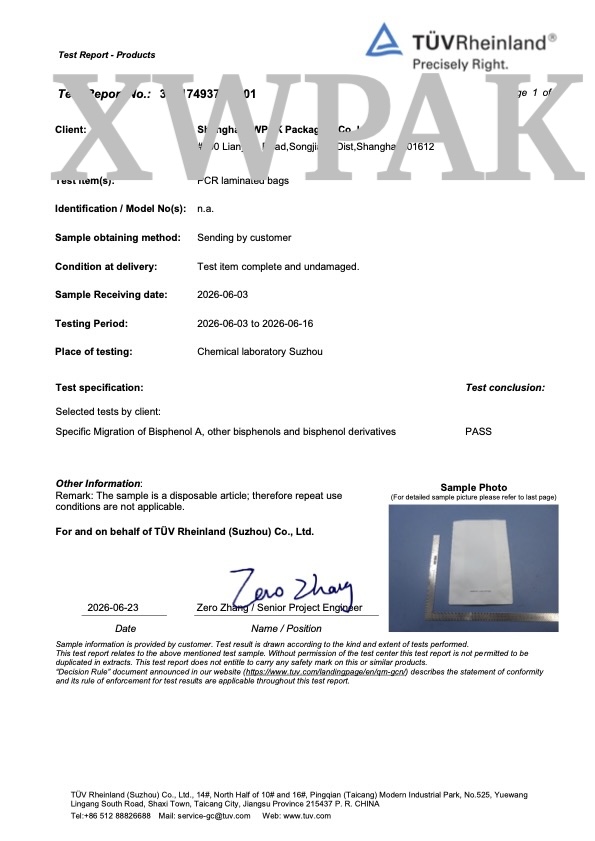 Test Report - Page 1 | 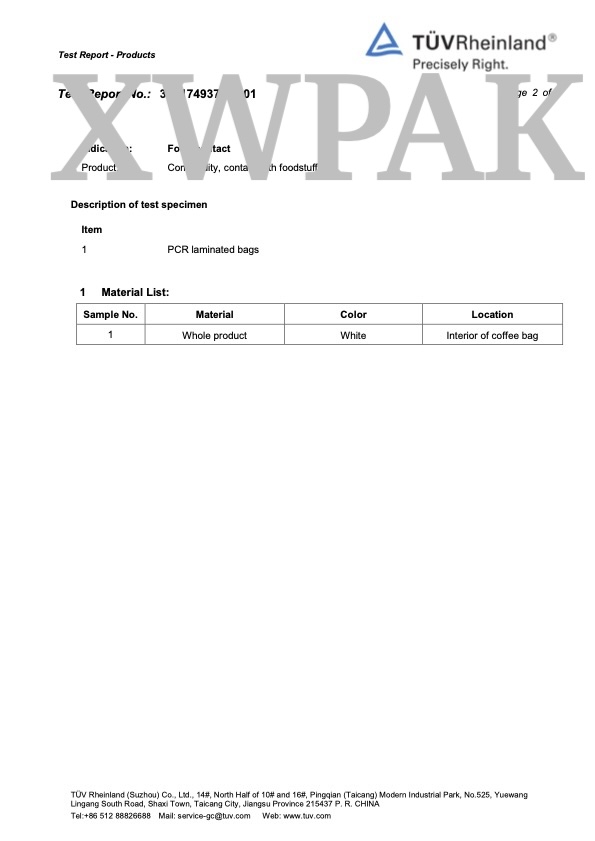 Specimen - Page 2 | 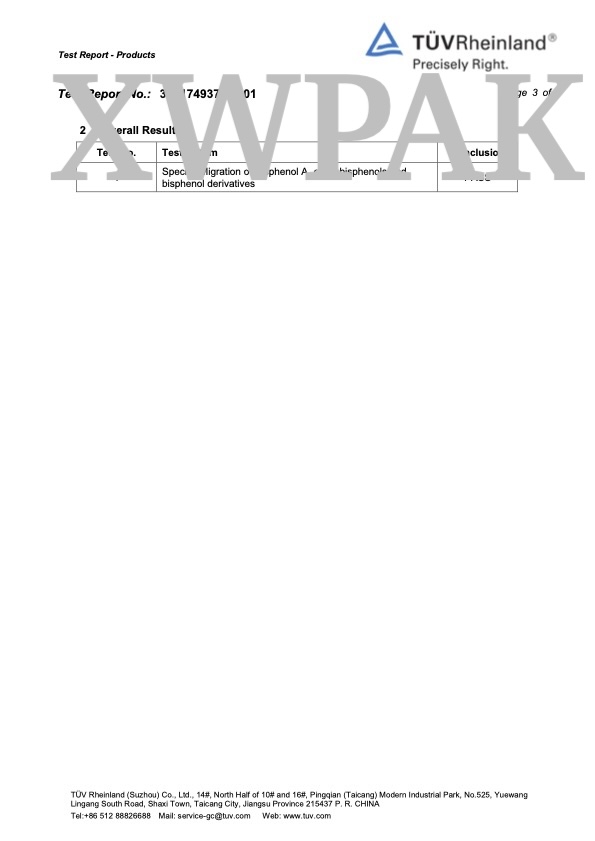 Result: PASS - Page 3 |
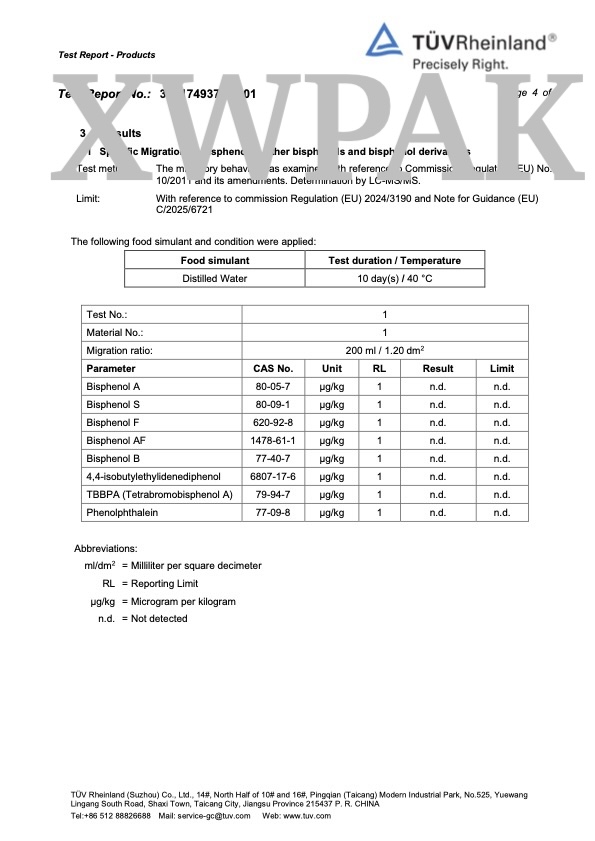 LC-MS/MS Results - Page 4 | 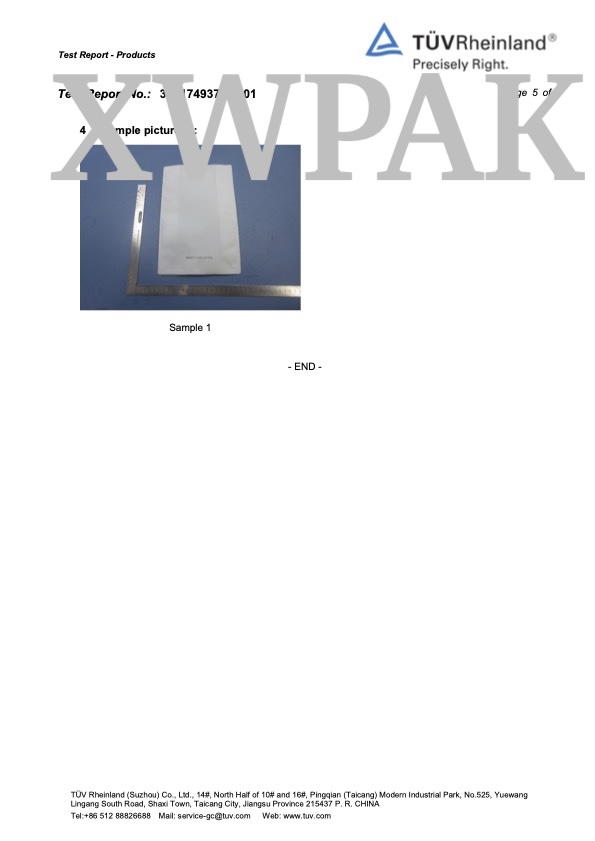 Sample Photo - Page 5 |  Terms - Page 6 |
Test Report 304174937a5: Specific Migration of Bisphenol A and related compounds under EU 2024/3190 and Note for Guidance C/2025/6721. All 8 bisphenol compounds not detected. PASS.
Key Takeaway: Five separate migration tests. Five clean results. Conducted by TUV Rheinland against the most current EU standards including the 2024/2025 bisphenol framework. The Attestation of Conformity was issued June 17, 2026. These are current documents, not historical paperwork from a previous production batch.
Most food contact compliance documentation in the flexible packaging industry covers virgin material structures. BOPP, PET, and LDPE films made from new polymer have predictable chemical profiles. PCR material does not. Post-consumer recycled content carries the chemical history of its previous use, which means a PCR laminate needs more rigorous incoming material control, tighter process parameters, and more thorough finished-product testing to reach the same compliance outcome as a virgin structure.
The fact that XWPAK's PCR laminated bag passed all five EU migration tests is a direct statement about material sourcing and manufacturing discipline. A PCR film that leaches metals, phthalates, or PAAs has a contamination problem somewhere upstream, either in the recycled feedstock, the adhesive, or the lamination process itself. A clean result across all five categories means those upstream variables are under control. That is not something every supplier offering PCR packaging can demonstrate with third-party documentation.
A supplier saying their bags are food safe and a supplier producing a TUV Rheinland test report are two different things. When evaluating flexible packaging for food contact applications, the documentation worth asking for includes the actual test reports with substance-level data, not just a certificate summary. The certificate tells you pass or fail. The report tells you what was tested, at what detection limit, and what the specific result was for each compound. That level of transparency matters when a brand's food safety team or an EU retailer's compliance auditor reviews the supplier file.
It also matters which regulation the testing references. EU Regulation 10/2011 is the current framework for food contact plastics. The bisphenol category now references the 2024/2025 update, which is more stringent than earlier versions. A supplier whose documentation only references older frameworks may not be current. XWPAK's testing was conducted in June 2026 against the most current applicable standards, which means buyers using this documentation for EU market compliance have a current basis, not an outdated one.
Important Note: This testing covers XWPAK's PCR laminated bag structure as tested. Brands requiring food contact compliance documentation for specific custom configurations should request testing confirmation relevant to their exact material specification. Different laminate structures, substrates, or adhesive systems may produce different results and may require independent verification.
Flexible packaging manufacturers in China range from large commodity converters to smaller specialty operations. The majority produce standard virgin material structures and can provide basic food contact declarations. A smaller subset invests in PCR material capabilities. A smaller subset still subjects those PCR structures to full independent migration testing across multiple hazardous substance categories and obtains formal attestation from a body like TUV Rheinland.
XWPAK sits in that last group. Combined with FSC certification for responsible fiber sourcing, BPI certification for compostable products, and ISO 9001 quality management accreditation, the TUV Rheinland food contact documentation adds a chemical safety layer that most buyers sourcing flexible packaging from Asia are not receiving from their current suppliers. For brands that have faced retailer compliance requests, import documentation requirements, or ingredient-conscious consumer scrutiny, the existence of this documentation changes the conversation with a prospective packaging supplier.
Request XWPAK's Full Compliance Documentation If you are sourcing food-contact flexible packaging and need supplier documentation for EU market compliance, retailer audits, or internal sign-off, we can provide the full TUV Rheinland test package alongside our other certifications. Contact XWPAK |